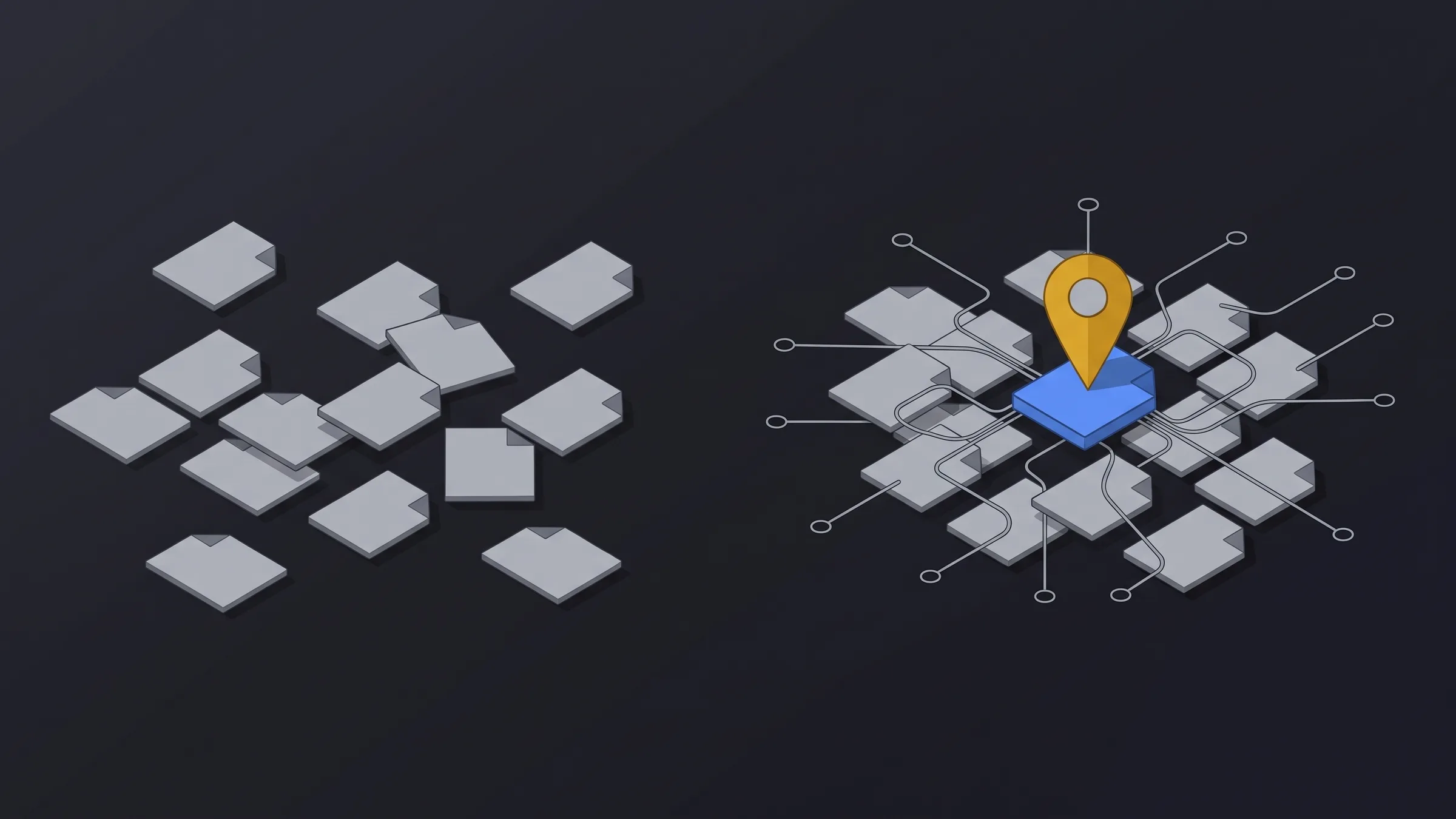


Most SEO campaigns chase individual keyword rankings one page at a time. Topical authority works differently: build it properly and you rank for hundreds of queries you never directly targeted, and those rankings hold when a competitor tries to outrank you on a single page. Here is how I actually build it, including the parts that don't fit neatly into a six-step listicle.
What Is Topical Authority?
What is topical authority? It's the state where a search engine treats your site as the most complete, reliable source on a specific subject, so new pages you publish in that subject rank faster and hold their position longer than they would on their own.
The concept traces back to Koray Tugberk Gubur, who framed it as Topical Coverage multiplied by Historical Data: how completely you cover a subject, combined with the accumulated ranking stability and engagement history Google has recorded for your site on that subject. He later added Cost of Retrieval to the framework, the idea that Google favours sites that make the correct answer cheap to find and verify, with less crawling, less disambiguation, less checking against other sources.
None of this is a number you can look up. Google doesn't publish a topical authority score, and no third-party tool measures the real thing, only proxies for it. That matters, because a fair chunk of the SEO industry treats "topical authority" as a certainty you can dial up like a keyword density score. It isn't. It's a description of a pattern that shows up repeatedly in ranking data: sites that cover a topic completely and consistently tend to out-rank sites that cover it in isolated fragments, even when the fragmented site has more backlinks. Surfer SEO's analysis of roughly 253,800 search results found page-level topical coverage was one of the strongest on-page signals tied to higher rankings, ahead of raw domain traffic volume. That's evidence for a real pattern, not proof of a formula Google runs.
Topical Authority vs Domain Authority
They get confused constantly and they measure different things. Domain Authority is a third-party score built from backlinks, Google doesn't use it. Topical authority is computed per subject, built from coverage, internal structure, and consistency, and it's why a DR 25 site with 40 comprehensive articles on one subject regularly outranks a DR 60 generalist site with one thin page on the same subject.
Step 1: Define Your Topical Scope
Pick a subject narrow enough that you can realistically cover it completely, and broad enough to contain commercial value. "Non-surgical facial treatments in Reading" is a scope. "Aesthetics" is not; you'll spend two years publishing and still be a third of the way through it.
List your three highest-revenue service areas, then pick the one where you have the deepest first-hand expertise and the thinnest competitor coverage. Start there. Expand once that scope is genuinely done, not once you've got bored of it.
Step 2: Build the Topical Map
What is a topical map? It's the document listing every query your audience asks within your scope, organised so the relationships between queries are visible before you write a word.
I use three tiers:
Root: the broad categories inside your scope ("cheek filler", "skin rejuvenation").
Node: the mid-level subtopics inside each root ("cheek filler vs implants", "filler migration").
Seed: the specific long-tail questions inside each node ("how long does cheek filler last", "cheek filler aftercare day by day", "can you exercise after cheek filler").
Generate the seed layer the same way an LLM would fan a query out into sub-questions: for every node, list what a reader would ask next, what a competitor's article leaves unanswered, and what a person would type into ChatGPT if the first answer didn't satisfy them. That fan-out list is your seed layer. It's also, increasingly, the mechanism AI Overviews use to decide who gets cited: Surfer SEO's study of 173,902 URLs found pages ranking for multiple fan-out queries were 161% more likely to be cited in an AI Overview than pages ranking for the main query alone, with a 0.77 correlation between fan-out query coverage and citation odds. A topical map built properly for Google is largely the same map an AI answer engine rewards.
more likely to be cited in an AI Overview when a page ranks for multiple fan-out queries
correlation between fan-out query coverage and AI Overview citation odds
Most workable topical maps run 30 to 80 pieces per cluster, not because that's a magic number but because it's roughly the point where a root topic's real sub-questions are exhausted without padding the map with duplicate intent. If you're inventing seed queries nobody would actually type, you've overshot the cluster and started diluting it, which is exactly the problem covered below in pruning. This is the same exercise I run whenever I build a topical map for a client, root and node first, seed layer stress-tested against real queries before anyone writes a page.
Step 3: Sequence Publishing, Don't Batch It
Publish root and node content first, the hub pages. Then fill in seed content underneath, linking back up. Don't publish fifty scattered seed pages before a single hub exists to receive them; a search engine reads that as fragmentation, not depth.
On my own sites, this is a hard sequencing rule, not a preference: no seed page goes live until its node hub is published and internally linked, because a spoke with nowhere to point loses most of its value. A cluster with 15 finished, interlinked pages reads as more authoritative than one spread thin across 50 subtopics, and it ranks that way too.
A cluster with 15 finished, interlinked pages reads as more authoritative than one spread thin across 50 subtopics, and it ranks that way too.
Publication velocity matters more than most people budget for. A site publishing two solid pieces a week for six months builds more durable authority signal than one that publishes twenty in a sprint and then goes quiet for a quarter. Sporadic bursts reset the momentum Google's historical-data component is measuring.
Step 4: Build the Internal Linking Architecture
Use hub and spoke, and apply it without exceptions. Every spoke (seed and node content) links back to its hub. The hub links out to every spoke beneath it, not a selection of the best ones. Related hubs link sideways to each other where the topics genuinely overlap. Your commercial or conversion pages get links from whichever pages in the cluster carry the most authority, usually the hub and the two or three spokes with the strongest rankings.
Keep the ratio realistic: a 15-page cluster needs at minimum 15 internal links pointing at its hub from cluster content alone, on top of anything from navigation or a homepage feature. If a hub has fewer inbound links than it has spokes, something in the cluster isn't linking back yet, go and check. I map this internal linking architecture for clients before a single new page goes live, because retrofitting it across an existing cluster takes far longer than building it in from the first page.
Step 5: Prune and Consolidate as You Build
This is the step most topical authority guides skip, and it's often the difference between a cluster that ranks and one that doesn't. Thin, overlapping, or outdated pages inside a cluster dilute the signal rather than adding to it. If two seed pages answer nearly the same question, merge them into one stronger page rather than leaving both live and half-finished. Fewer, deeper pages read as more authoritative than more, thinner ones, and AI systems in particular favour a single clear answer per topic over several competing half-answers from the same domain.
Run this check every time you add five or six new pieces to a cluster, not once a year: does anything here now overlap, and does anything here still deserve to exist.
How Long Does Building Topical Authority Take?
Low-competition subjects show initial signal within three to six months. Medium competition needs six to twelve. High competition, the kind with entrenched DR 70+ publishers already covering it in depth, is a twelve to twenty-four month build. Those ranges assume consistent publishing at the cadence above; a stop-start schedule doesn't only slow the timeline, it resets it, because the historical-data half of the equation depends on continuity.
to initial signal on a low-competition subject
to initial signal on a medium-competition subject
build time against entrenched DR 70+ publishers
One of my clients went from 180 to 620 organic visits a month in nine months on this methodology. I've also had clusters that took the full two years to show it, in subjects where the top of the SERP was already occupied by publishers with a decade of head start. Say which one you're in before you commit a budget to it.
One of my clients went from 180 to 620 organic visits a month in nine months on this methodology.
How Do You Measure Progress?
Not with a single score, because there isn't one. Track the percentage of your topical map that's published and indexed, the average ranking position across the whole cluster rather than the hub alone, and impressions growth in Google Search Console for the cluster as a set. A hub ranking well while its spokes sit unindexed is a map that's half-built, not a finished authority signal, whatever the hub's own position suggests.
Is Topical Authority Real, or a Semantic-SEO Rebrand?
Worth addressing directly, because there's a real practitioner debate about it. The sceptical case, made well by SEOs who've watched the term get overused, is that "topical authority" often repackages content clusters, internal linking, and E-E-A-T under one label, that it isn't directly measurable, and that some of what gets sold as topical authority strategy is closer to a familiar checklist with a new name on it.
I think that critique lands on the marketing around the term more than the underlying mechanism. The pattern itself, comprehensive coverage compounding into faster rankings and more durable positions, shows up consistently across the sites I run and in the independent SERP data cited above. What the sceptics are right about is that comprehensiveness on its own isn't the differentiator: being the only source with a specific piece of information, or answering a question nobody else has bothered to, moves the needle more than adding a fortieth generic article to a well-covered topic. Build the map for coverage. Write the individual pages for the gaps nobody else has filled.
Related Articles
- What Is Entity SEO? Build Your Digital Identity for Google: entity authority is the foundation topical authority sits on
- Topical Authority vs Domain Authority: Which Matters More?: why topical coverage beats link metrics
- What Is E-E-A-T in SEO?: how experience and expertise signals reinforce authority
- What Is a Content Brief?: the document that keeps each piece inside the map's scope
I map topical scope, build the cluster architecture, and sequence the publishing for clients as a Reading-based SEO consultant. Contact me if you want a second opinion on where your own topical map has gaps.