I've reviewed hundreds of SEO reports. The ones that reach board decks are almost always the wrong ones.
They report activity — pages published, keywords tracked, backlinks acquired. A board member reads "we now rank for 2,400 keywords" and has no idea whether that's good, bad, or irrelevant. (It's usually irrelevant.)
The problem isn't that SEO teams lack data. It's that they report metrics designed to impress other SEOs, not to inform business decisions. Domain Authority means nothing to a CFO evaluating marketing spend. Total impressions without context is noise.
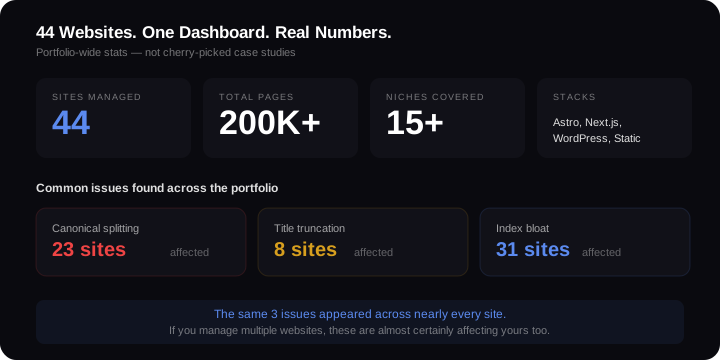
I manage 44 websites and report on all of them. Through trial and error — and some uncomfortable board conversations — I've narrowed it down to five metrics that actually predict whether SEO is working. These are the numbers that connect organic search to the P&L.
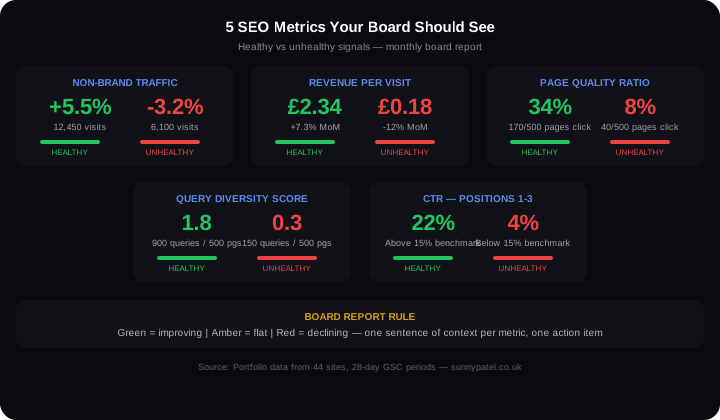
Why Most SEO Reports Fail at Board Level
Board members care about three things: revenue, risk, and competitive position. Most SEO reports address none of them.
A typical monthly SEO report includes:
- Total organic sessions (up or down, no context)
- Domain Authority score (a third-party estimate, not a Google metric)
- Number of keywords ranking on page one (half of which are brand terms)
- Backlinks acquired (no quality distinction)
- Pages published (activity, not outcome)
None of these answer the question a board is actually asking: is our investment in SEO generating returns, and is that return growing or shrinking?
Here's what to report instead.
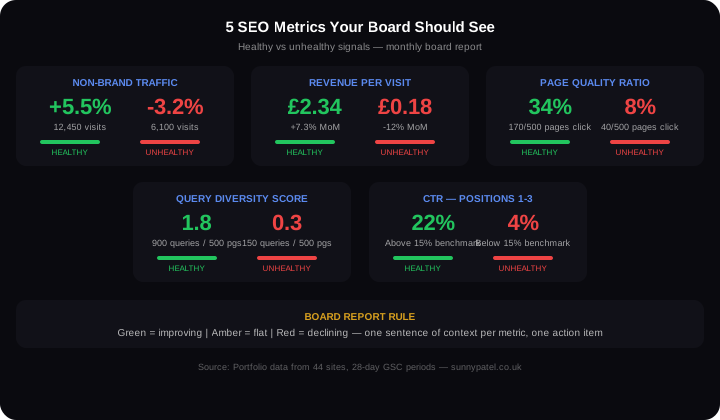
Metric 1: Non-Brand Organic Traffic Trend
This is the single most important metric. Non-brand traffic measures visits from people who searched for what you sell — not your company name.
If someone searches "your company name" and clicks your result, that's brand awareness working. It's not SEO. The person already knew about you. SEO's job is to capture the people who don't know you yet — those searching "best CRM for small business" or "how to reduce employee turnover."
How to calculate it: In Google Search Console, filter out queries containing your brand name and variations. The remaining traffic is non-brand. Track it as a monthly trend line.
From my portfolio data, brand traffic typically accounts for 15-40% of total organic visits on established sites. On newer sites, it's under 5%. If your SEO team reports total organic traffic without splitting out brand, they're inflating their numbers.
Healthy signal: Non-brand traffic rising month-over-month, even by 3-5%. Red flag: Non-brand flat or declining while total organic rises — that means brand awareness is carrying the numbers and SEO isn't generating new demand.
Metric 2: Revenue Per Organic Visit
This metric connects SEO directly to the P&L. It answers: for every visitor organic search delivers, how much revenue do we generate?
Formula: Organic search revenue / total organic visits = revenue per organic visit.
Track this monthly. The number itself varies wildly by industry — an e-commerce site might see £0.40-£2.50, a SaaS company £3-£15, a lead-gen business £5-£50 depending on deal size and close rate.
The absolute number matters less than the trend. If revenue per visit is rising, your SEO team is attracting better-qualified traffic — people closer to a buying decision. If traffic is rising but revenue per visit is flat or falling, you're ranking for the wrong queries.
I've seen this pattern on affiliate sites I manage: traffic doubles after a content push, but earnings stay flat because the new pages target informational queries with no commercial intent. The SEO statistics for the UK market show that top-of-funnel content converts at roughly one-tenth the rate of bottom-of-funnel pages. Volume without intent is vanity.
Board presentation tip: Show this as a dual-axis chart — organic visits on the left axis, revenue per visit on the right. The ideal picture is both lines trending upward.
Metric 3: Indexed Page Quality Ratio
This metric tells the board whether your website is an asset or a liability.
Formula: Pages receiving 1+ organic click (last 90 days) / total indexed pages.
If you have 500 pages indexed in Google but only 50 receive any clicks in a quarter, your quality ratio is 10%. That means 90% of your index is dead weight — consuming crawl budget, diluting site quality signals, and contributing nothing.
From my portfolio, quality ratios range from 8% on sites with programmatic content (thousands of auto-generated pages, few with real demand) to 65% on tightly curated editorial sites. Most businesses land between 20-40%.
Healthy signal: Quality ratio above 30%, or rising over time. Red flag: Ratio below 15%, or total indexed pages growing while clicking pages stay flat. That means you're publishing content nobody searches for.
This metric also functions as an early warning for technical SEO issues. A sudden drop in quality ratio often means Google has started indexing thin pages, parameter URLs, or duplicate content that was previously excluded.
Metric 4: Query Diversity Score
How many distinct search queries drive traffic to your site? This measures resilience.
Formula: Queries with 1+ click (28 days) / total indexed pages.
A site that gets 80% of its traffic from five keywords is fragile. One algorithm update, one new competitor, one featured snippet change — and revenue drops overnight. A site ranking for 500+ distinct queries has diversified, defensible traffic.
I track this across all 44 sites. The ones that survived Google's March 2025 core update best had query diversity scores above 2.0 (more than two clicking queries per indexed page). Sites below 0.5 were hit hardest.
Healthy signal: Score above 1.0 and rising. Red flag: Score below 0.5, or declining — it means you're becoming more dependent on fewer keywords, even if total traffic looks stable.
For boards evaluating how long SEO takes to produce results, query diversity is the leading indicator. Traffic can be volatile month to month, but if the number of distinct queries driving visits is growing, the SEO programme is building a wider foundation. Revenue follows.
Metric 5: Click-Through Rate by Position Bracket
Rankings are only half the story. CTR tells you whether those rankings convert into actual visits.
Benchmarks from my portfolio data across 44 sites:
- Positions 1-3: 15-30% CTR expected
- Positions 4-7: 5-10% CTR expected
- Positions 8-10: 2-5% CTR expected
If your page ranks in position 3 but only gets 4% CTR, something is wrong with how it appears in search results. The title is weak, the meta description doesn't match search intent, or a competitor's rich snippet is stealing attention.
This is where I've seen the biggest quick wins. On one site in my portfolio, rewriting title tags on 8 pages ranking in positions 1-5 with below-benchmark CTR increased total clicks by 23% in 14 days. No ranking change needed — just better packaging of existing positions.
Board presentation tip: Show a scatter plot — X-axis is average position, Y-axis is CTR. Plot each landing page. Pages below the benchmark line represent immediate optimisation opportunities.
What to Stop Reporting
If these five metrics are what boards need, here's what you can safely remove from the deck:
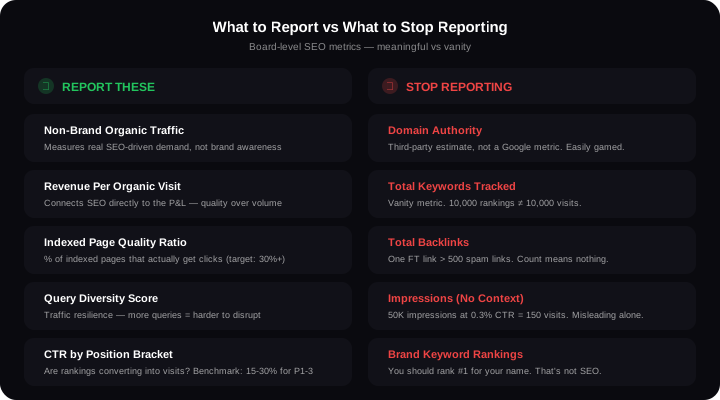
- Domain Authority — A Moz invention, not a Google metric. Can be gamed with cheap links. Tells you nothing about revenue.
- Total keywords tracked — Vanity metric. Ranking for 10,000 keywords means nothing if 9,800 of them generate zero clicks.
- Total backlinks — One relevant link from the Financial Times is worth more than 500 from spam directories. The number alone is meaningless.
- Impressions without context — "We got 50,000 impressions" sounds good until you realise CTR was 0.3%. Impressions without click data is incomplete information.
- Brand keyword rankings — You should rank number one for your own name. If you don't, that's a problem to fix, not a metric to track.
The One-Page Board Report Template
Here's how to present all five metrics on a single slide. I use this format for SEO due diligence reports as well — investors evaluating acquisitions want the same clarity.
Layout: five cards, one row, traffic-light colours.
| Metric | This Month | Last Month | Signal |
|---|---|---|---|
| Non-brand organic visits | 12,450 | 11,800 | Green (+5.5%) |
| Revenue per organic visit | £2.34 | £2.18 | Green (+7.3%) |
| Indexed page quality ratio | 34% | 31% | Green (improving) |
| Query diversity score | 1.8 | 1.6 | Green (widening) |
| CTR (positions 1-3) | 22.1% | 18.4% | Green (above benchmark) |
Three rules for presenting this:
- Use directional arrows and colour coding. Green for improving, amber for flat, red for declining. Board members scan visually before reading numbers.
- Include one sentence of context per metric. "Non-brand traffic rose 5.5% after publishing 4 new product comparison pages targeting bottom-of-funnel queries."
- Add a single action item. "Next month: rewrite title tags on 12 pages with below-benchmark CTR to convert existing rankings into clicks."
The Bottom Line
SEO reporting to boards fails because SEO teams report what's easy to measure, not what matters. Domain Authority takes five seconds to check. Revenue per organic visit requires connecting analytics, Search Console, and your CRM.
The five metrics above take more effort to compile. But they answer the only question a board is asking: is this investment working, and should we increase it?
If your SEO team can't produce these numbers, that tells you something too.