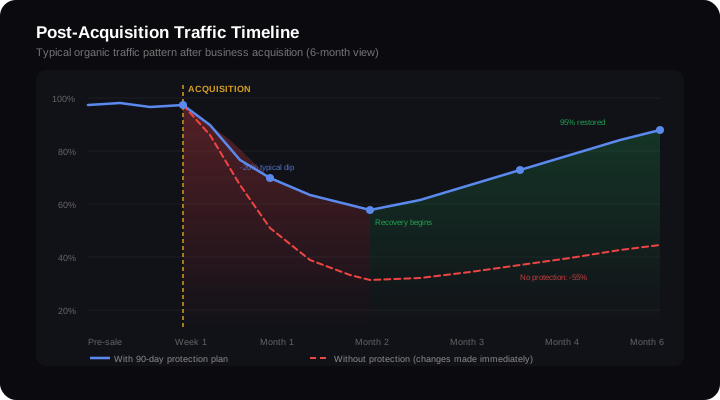
I've reviewed the SEO data on 44 websites over the past two years. Not client sites where I see the good version — my own properties, where I see everything. The messy Google Search Console reports. The traffic that looks great until you filter by query type. The technical debt hiding under a clean homepage.
That experience taught me something investors rarely hear: the organic traffic number in a pitch deck is almost always wrong. Not fraudulently wrong. Structurally wrong. And if you don't know how to read the data behind it, you'll overpay for traffic that's already declining.
This is what I check before anyone should sign.
Why Organic Traffic Numbers in Pitch Decks Mislead
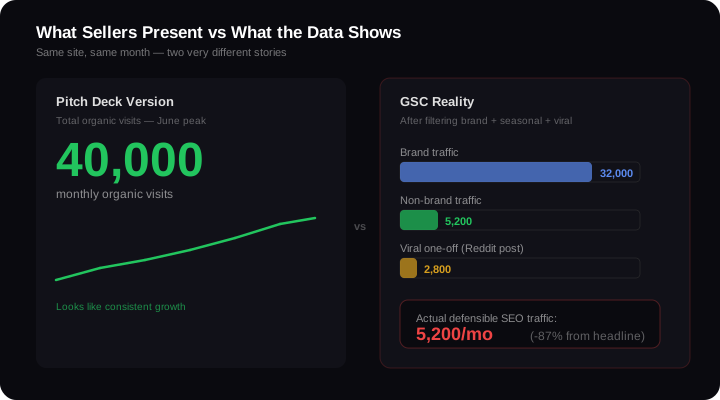
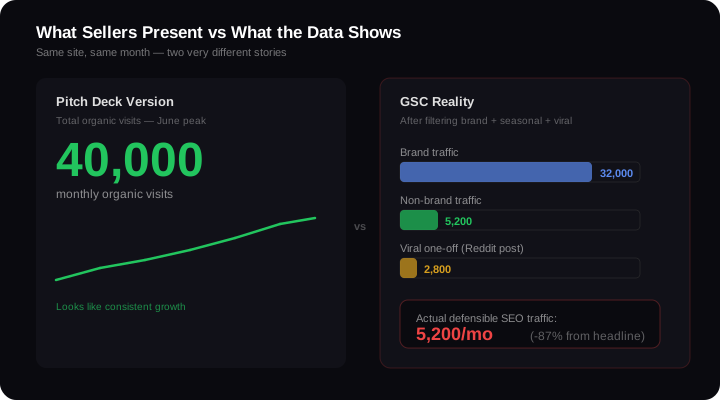
Sellers present organic traffic as a single number. "40,000 monthly visits from Google." Sounds strong. But that number hides three problems.
Brand vs non-brand traffic. If 32,000 of those visits come from people searching the company name, the site's SEO isn't driving discovery — its brand awareness is. Strip out brand queries and you might find only 8,000 visits from actual organic ranking. That's an 80% haircut on the headline number.
Seasonal spikes. A gardening site showing 40,000 visits in June might average 9,000 across winter months. Sellers pick the peak month. You need 12 months minimum — 16 months is better, so you can compare year-on-year.
One-off viral content. A single blog post that hit Reddit or Hacker News can inflate a 3-month average by 300%. That traffic doesn't come back. Filter by page in Google Search Console and check whether traffic is distributed or concentrated.
If the seller won't give you direct Google Search Console access, walk away. Third-party tools like Ahrefs and SEMrush estimate traffic — they don't measure it. I've seen Ahrefs overestimate a site's traffic by 4x and underestimate another by 60%.
The 5 Things to Check in Google Search Console Before Buying
These are the five reports I open first when evaluating any acquisition target. They take 30 minutes and they'll tell you more than a 50-page pitch deck.
1. Indexed Pages vs Actual Content
Go to Pages > Indexed. Compare that number to the actual pages on the site. If the site has 200 blog posts but Google has indexed 1,400 pages, there's index bloat — tag pages, parameter URLs, pagination, or duplicate content Google shouldn't be crawling.
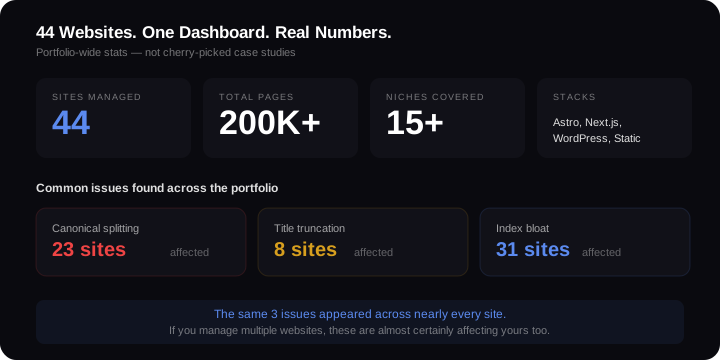
I found this on 31 of my 44 sites. Index bloat dilutes crawl budget and can suppress rankings on the pages that actually matter.
2. Canonical Issues
Under Pages, look for "Duplicate, Google chose different canonical" and "Alternate page with proper canonical tag." These mean Google found multiple versions of the same content and had to pick one.
On one of my sites, a single trailing slash inconsistency split ranking signals across 23 pages. The fix improved average position by 6 places in 10 days — but an investor looking at top-line traffic would never have spotted the problem. I've written about this pattern in detail here.
3. Manual Actions
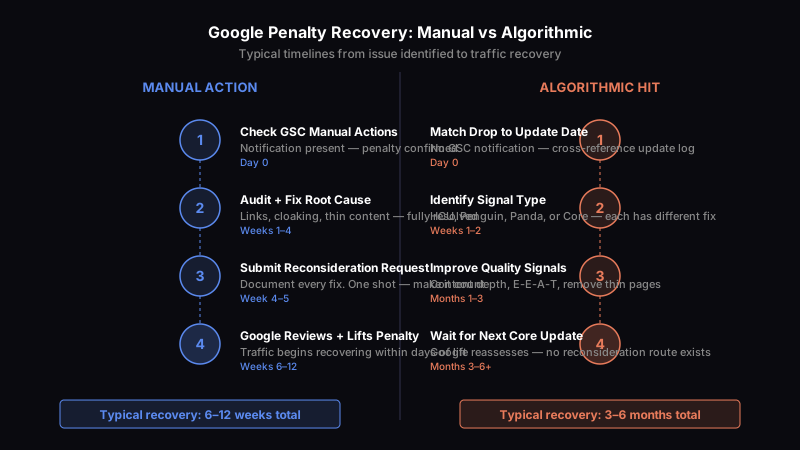
Security & Manual Actions > Manual Actions. This is non-negotiable. A manual penalty means Google has flagged the site for violating guidelines — thin content, unnatural links, or spam. Recovery takes 3-12 months with no guarantee of full restoration.
If there's an active manual action, the site's organic traffic has an expiry date.
4. Traffic Trend by Query Type
In Performance, filter by query. Separate branded queries (company name, domain name, product names) from non-brand queries. Then look at the 12-month trend for non-brand only.
Stable or growing non-brand traffic = organic SEO is working. Declining non-brand traffic = the site is losing ground to competitors, regardless of what the total number shows.
5. Mobile vs Desktop Split
Check the device filter. If 80%+ of traffic comes from desktop in a B2C niche, something's wrong — either the site has mobile usability issues suppressing rankings, or the traffic is coming from non-consumer sources (scrapers, bots, internal employees).
For most B2C businesses, mobile should represent 60-75% of organic traffic. A desktop-heavy split in a consumer niche is a signal to investigate further.
Technical Debt That Doesn't Show in Traffic Numbers
Traffic can look stable while the site accumulates technical problems that will suppress future growth. These are the three I find most often.
Trailing slash splits. Two versions of every URL being indexed, each collecting half the ranking signals. I found this on 23 of 44 sites in my portfolio. It doesn't crash traffic overnight — it just prevents pages from ranking as high as they should.
Index bloat. Google indexing thousands of pages that add no value: empty tag archives, paginated listings, parameter variations. This wastes crawl budget and can trigger quality filters at scale. One of my sites had 1,400 indexed pages for 200 real articles.
Title truncation. Pages ranking on page one with 0.2% click-through rates because Google truncates their titles at 55-60 characters. I found this pattern across 8 sites with programmatic content — the salary data example is the clearest case.
None of these show up in a traffic dashboard. All of them suppress revenue.
How to Evaluate Whether SEO Traffic Is Defensible
Not all organic traffic is created equal. Some traffic survives algorithm updates. Some vanishes overnight. Here's how to tell the difference.
Topical Authority vs Single-Keyword Dependence
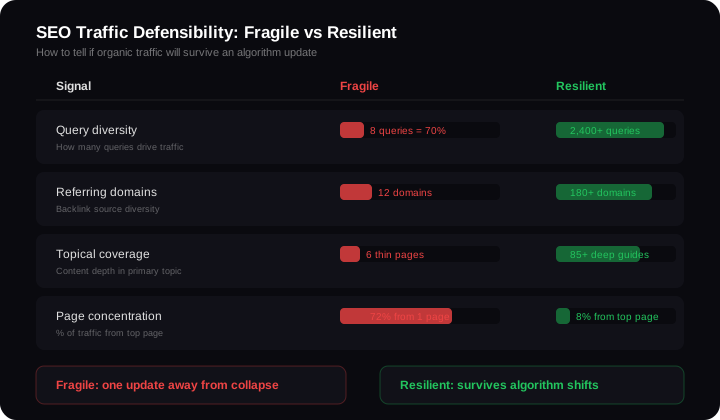
Check how many unique queries drive traffic. If 50%+ of non-brand traffic comes from fewer than 10 queries, the site is fragile. One algorithm shift or one new competitor can wipe out half the organic channel overnight.
Sites with genuine topical authority spread traffic across hundreds or thousands of queries. They rank for long-tail variations because Google recognises them as comprehensive sources on a topic. That's defensible.
Backlink Quality
Export the backlink profile from Ahrefs or Moz. Look for:
| Signal | Healthy | Dangerous |
|---|---|---|
| Referring domains | Diverse, editorial sites | Concentrated in 5-10 domains |
| Anchor text | Varied, natural language | Exact-match keyword anchors |
| Link sources | News sites, industry blogs, directories | PBNs, guest post farms, link exchanges |
| Growth pattern | Gradual over years | Spikes from link building campaigns |
A site with 500 backlinks from 40 referring domains is more fragile than one with 200 backlinks from 180 domains. Diversity matters more than volume.
Red Flags That Should Kill a Deal
These aren't yellow flags. If you find any of these, either renegotiate the price significantly or walk away.
- 80%+ brand traffic. The SEO isn't working. You're buying brand awareness, not organic discovery. If the brand doesn't transfer cleanly (and it rarely does in acquisitions), that traffic disappears.
- Declining non-brand traffic over 6+ months. Something structural is wrong — either a Google algorithm update hit the site, a competitor overtook it, or the content is decaying. Reversing a 6-month decline takes another 6-12 months. Budget for that.
- Active manual penalties. Recovery is uncertain. Timeline is long. And the penalty may indicate deeper issues with the site's link profile or content quality.
- PBN backlinks. Private blog networks are a ticking time bomb. Google's spam team detects them in waves. If the site's authority relies on PBN links, a future cleanup could drop traffic by 40-70%.
- Single-page traffic concentration. If one page drives 60%+ of organic traffic, you're not buying a site — you're buying a page. One SERP change and the business model breaks.
What a Proper SEO Due Diligence Audit Includes
If organic traffic represents more than 20% of the business's revenue, you need a technical SEO audit before closing. Here's what it should cover:
- Google Search Console deep dive — the 5 checks above, plus Core Web Vitals, crawl stats, and structured data errors
- Backlink forensics — full profile export, PBN detection, anchor text distribution, and penalty risk scoring
- Content quality assessment — thin content ratio, duplicate content percentage, and content decay analysis
- Technical infrastructure review — hosting stability, page speed, mobile rendering, JavaScript dependencies that could break indexing
- Competitive position mapping — where the site ranks vs competitors for its top 50 non-brand queries, and the trajectory of those positions
- Traffic valuation — what the organic traffic is actually worth based on equivalent PPC cost, adjusted for brand vs non-brand split
This isn't a 30-minute job. A thorough audit takes 2-3 days and should cost £500-£2,000 depending on the site's size. That's a rounding error on most acquisition prices — and it's the difference between buying a growing asset and inheriting someone else's technical debt.
The Bottom Line
Organic traffic is one of the most valuable assets in a digital business. It's also one of the most misunderstood. The number in the pitch deck tells you almost nothing. The data behind it tells you everything.
Before you sign, get Google Search Console access. Run the five checks. Look at query-level data, not aggregates. And if the seller hesitates to share raw data, that tells you something too.
I've written more about the technical patterns that affect multi-site portfolios in managing 44 websites with real SEO data, and about how long SEO improvements actually take to show results — both relevant context if you're modelling post-acquisition growth.