85.19% of all blog traffic comes from organic search (SeoProfy). Not social media. Not email. Not paid ads. Organic search. That single statistic reframes how businesses should think about content marketing — it is, fundamentally, an SEO discipline. The companies creating comprehensive, research-backed content built on semantic SEO principles are the ones capturing that traffic. The rest are publishing into a void.
This page compiles the most important content marketing statistics for 2026, drawn from industry research by HubSpot, Orbit Media, BrightEdge, First Page Sage, and others. Every figure is cited. Use these benchmarks to evaluate your own content strategy, justify investment, and identify where your approach falls short.
Content Marketing Industry Overview
The content marketing industry has matured from a tactical experiment into a core business function. The data confirms this shift.
$107.5 billion — projected global content marketing revenue by 2026, up from $63 billion in 2022 (Research Dive). That growth rate reflects businesses reallocating budget from channels with declining returns toward content that compounds over time.
82% of businesses actively use content marketing as part of their strategy (Typeface). This is no longer an optional marketing channel. If your competitors are investing in content and you are not, the gap widens with every month of inaction.
Blog and SEO content ranked #1 for ROI among B2B marketing channels (HubSpot State of Marketing 2024). Ahead of social media. Ahead of paid advertising. Ahead of email marketing. The channel that requires the most patience delivers the strongest returns.
49% of marketers say organic search delivers the best ROI of any marketing channel (HubSpot). Nearly half the industry agrees — search is where the money is. This aligns with the traffic data: if 85% of blog traffic arrives through search, the return on investment naturally follows the traffic source.
73% of B2B marketers and 70% of B2C marketers use content marketing as part of their overall strategy (Content Marketing Institute). The distinction between B2B and B2C adoption has narrowed considerably — both sectors now treat content as essential infrastructure.
These figures paint a clear picture. Content marketing is not a trend. It is a $107.5 billion industry where the majority of businesses are actively competing. The question is not whether to invest, but whether your investment is structured to win.
Blog Traffic Statistics
Understanding where blog traffic actually comes from determines how you should create content. The data overwhelmingly points in one direction.
85.19% of all blog traffic comes from organic search (SeoProfy). This statistic, drawn from analysis across thousands of blogs, confirms that search engine optimisation is the primary traffic driver for content. Social media, email, and referral traffic combined account for less than 15%.
Blog posts remain the 3rd most popular content format at 38% adoption, behind short-form video and images (HubSpot). Despite the rise of video, written content maintains its position because it serves search intent directly. Users searching for answers find blog posts, not TikToks.
1,333 words — the average blog post length in 2025, continuing a declining trend from 1,416 words in 2021 (Orbit Media Annual Blogging Survey). The average is falling, but as you will see in the long-form section below, the bloggers reporting strongest results are writing significantly more than average.
SEO drives 1,000%+ more traffic than organic social media (BrightEdge). This figure is staggering but consistent with the 85% organic search traffic share. A social media post reaches a fraction of your audience for hours. A ranking blog post reaches new visitors every day for months or years.
68% of all online experiences begin with a search engine (BrightEdge). Your potential customers start their journey in Google, not on Instagram. Content that ranks captures demand at the point of highest intent — when someone is actively searching for what you offer.
These statistics justify a search-first content strategy. If you are creating content primarily for social media distribution, you are optimising for less than 15% of potential blog traffic. Keyword research ensures every piece of content targets queries your audience actually searches for, capturing the 85% that arrives through organic search.
Long-Form Content Performance
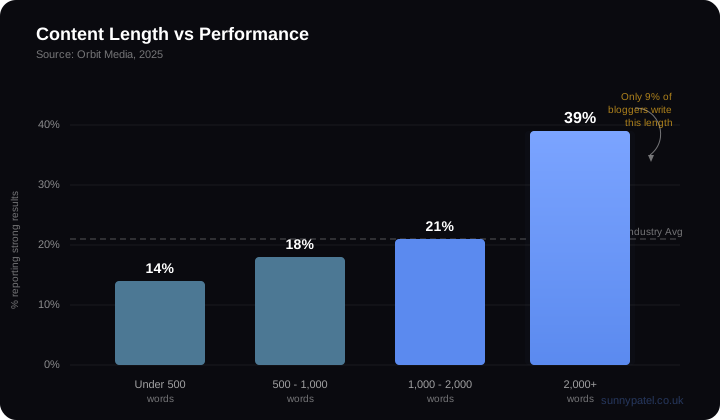
The data on content length reveals a significant gap between what most bloggers publish and what actually performs.
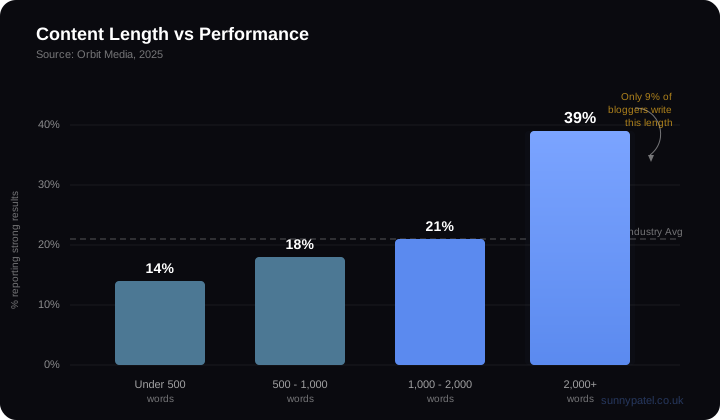
39% of bloggers who write posts of 2,000+ words report "strong results," compared to just 21% across all bloggers (Orbit Media Annual Blogging Survey). Long-form content nearly doubles the probability of strong performance.
Yet only 9% of bloggers create posts exceeding 2,000 words (Orbit Media). This is the opportunity. The vast majority of content on the internet is thin — and the data shows it underperforms. The bloggers willing to invest in comprehensive coverage are rewarded disproportionately.
Here is how results break down by word count:
| Word Count | % Reporting Strong Results | % of Bloggers Creating |
|---|---|---|
| Under 500 words | 12% | 4% |
| 500–1,000 words | 18% | 28% |
| 1,000–1,500 words | 21% | 32% |
| 1,500–2,000 words | 29% | 18% |
| 2,000–3,000 words | 36% | 12% |
| 3,000+ words | 39% | 5% |
Source: Orbit Media Annual Blogging Survey
The pattern is unmistakable. Longer content correlates with stronger results at every tier. The biggest jump occurs between 1,000–1,500 words (the average) and 1,500–2,000 words, where reported strong results increase from 21% to 29%.
This aligns directly with how topical authority works. Comprehensive content covering a topic exhaustively — answering every question, addressing every entity, providing every relevant detail — sends stronger authority signals to search engines than thin content addressing only the surface. Longer content naturally accommodates more semantic depth, more internal links, and more comprehensive coverage.
The lesson is not "write more words." It is "cover topics more completely." A 2,500-word article that exhausts a subject will outperform a 3,500-word article padded with filler. The word count is a proxy for thoroughness, not a target in itself.
My content brief service specifies word count targets based on SERP analysis — what length the top-ranking content actually uses — ensuring each piece is as comprehensive as necessary without being artificially inflated.
Publishing Frequency and Consistency
How often you publish matters. But consistency matters more than volume.
Bloggers who publish multiple times per week report substantially stronger results than those publishing weekly or monthly (Orbit Media). The data shows a clear correlation between publication frequency and reported outcomes:
- Daily or multiple times per week: highest proportion reporting "strong results"
- Weekly: moderate results, representing the baseline for serious content programmes
- Monthly or less: lowest proportion reporting strong results
Consistency outperforms bursts. A site publishing two quality articles per week for six months builds more authority than one publishing twenty articles in a single month then going quiet. Search engines interpret consistent publication as sustained expertise. Sporadic publishing resets momentum.
Content decay is real. Content published and never updated loses rankings over time. Google favours freshness for many query types, and competitors continuously publish new content targeting the same keywords. A content strategy that only creates new posts without updating existing ones is fighting with one hand tied.
HubSpot's own data shows that compounding blog posts — older posts that continue generating traffic — account for 38% of their total blog traffic (HubSpot). These are posts that were published months or years ago but continue ranking because they are comprehensive, well-structured, and periodically updated.
The practical implication: build a content calendar that includes both new content creation and systematic updates to existing content. A topical map provides the strategic framework for what to publish and in what order, ensuring every piece strengthens overall topical coverage rather than scattering effort across unrelated topics.
Content Marketing ROI
The return on investment from content marketing is where the data becomes compelling for budget discussions.
825% — the average ROI for SEO across all verticals, measured over a three-year period (First Page Sage). For every pound invested in SEO-driven content, businesses generate an average return of £8.25. Specific verticals exceed this significantly: real estate achieves 1,389% ROI, medical devices 1,183%, and higher education 994% (First Page Sage).
$22 revenue per $1 spent — the average return on content marketing investment (SeoProfy). This figure accounts for the full lifecycle of content: creation, optimisation, and the ongoing organic traffic it generates over months and years.
14.6% close rate for organic search leads, compared to just 1.7% for outbound leads such as cold calling and direct mail (First Page Sage). Organic leads convert at 8.5 times the rate of outbound leads. This makes intuitive sense — someone searching for "best content marketing consultant" has already identified their need. They are further down the buying journey than someone interrupted by a cold email.
61% lower cost per lead compared to paid advertising channels (First Page Sage). Content marketing requires higher upfront investment but generates leads at dramatically lower marginal cost as content compounds over time. A paid ad stops generating leads the moment you stop paying. A ranking blog post generates leads for years.
Content marketing costs 62% less than traditional marketing whilst generating approximately 3 times as many leads (DemandMetric). This cost efficiency explains why 82% of businesses have adopted content marketing — the economics are simply better than the alternatives.
These ROI figures assume strategic content creation. Publishing random blog posts without keyword research, semantic optimisation, or strategic internal linking produces significantly lower returns. The 825% ROI figure reflects businesses executing content marketing properly — with comprehensive topic coverage, search intent alignment, and technical SEO foundations.
Content Strategy Benchmarks
Beyond the headline statistics, several benchmarks help calibrate whether your content programme is performing at industry standard.
47% of buyers consume 3–5 pieces of content before engaging with a salesperson (DemandGen). Your content pipeline needs depth. A single blog post is not enough to nurture a buyer through their decision process. This reinforces the value of building topical authority — creating clusters of related content that guide readers from awareness through to decision.
72% of marketers say content marketing increases engagement (Content Marketing Institute). Engagement here means time on site, pages per session, and return visits — all signals that search engines interpret as quality indicators.
B2B companies allocate an average of 26% of their total marketing budget to content marketing (Content Marketing Institute). Among the most successful B2B marketers, that figure rises to 40%+. Budget allocation correlates with results because content marketing rewards sustained investment over time.
60% of marketers report that content marketing generates demand and leads (Content Marketing Institute). It is simultaneously the top channel for lead generation and the most cost-efficient — a combination that explains its dominance.
Companies with blogs generate 67% more leads per month than companies without (DemandMetric). The blog is not a nice-to-have. It is measurably the difference between generating leads and not generating leads at scale.
What These Statistics Mean for Your Content Strategy
The data points in one direction: businesses that create comprehensive, search-optimised content consistently outperform those that do not. But the gap between knowing this and executing it effectively is where most businesses fail.
Here is what the statistics tell you to do — and how to do it.
Invest in search-first content creation. With 85% of blog traffic from organic search and 1,000%+ more traffic from SEO than social, every piece of content should start with keyword and intent research. My keyword research service identifies the exact queries your audience uses, their search volume, and the competitive landscape for each.
Write comprehensive, long-form content. The 39% strong results figure for 2,000+ word posts compared to 21% average is not a coincidence. Comprehensive content ranks better, earns more backlinks, and serves user intent more completely. A content brief ensures each piece covers the topic exhaustively without padding — specifying the entities, questions, and structure needed for comprehensive coverage. My content brief service builds these specifications from real SERP data.
Build topical authority, not random content. Publishing isolated articles on unrelated topics does not build authority. Topical authority requires systematic coverage of a subject area — every question answered, every subtopic addressed, every entity covered. Learn how to build topical authority through the cluster-based methodology that compounds ranking signals.
Publish consistently. The correlation between publishing frequency and results is clear. Create a sustainable content calendar and stick to it. Weekly publication is the minimum viable frequency for building momentum.
Optimise for long-term ROI. With 825% average ROI and 14.6% close rates, SEO-driven content is the highest-returning marketing investment most businesses can make. But it requires patience. How long does SEO take? sets realistic timelines: 3–6 months for initial results, 6–12 months for significant authority.
Use semantic SEO principles. The content that ranks is not keyword-stuffed. It is semantically complete — covering related entities, answering related questions, and demonstrating genuine topic expertise. Semantic SEO is the methodology that transforms good content into ranking content.
If you want to increase organic traffic, these statistics provide the evidence base. The businesses winning at content marketing are not doing anything mysterious. They are creating better content, more consistently, with stronger strategic foundations.
Sources
- BrightEdge — "68% of online experiences begin with a search engine" and "SEO drives 1,000%+ more traffic than organic social media"
- Content Marketing Institute — B2B and B2C content marketing adoption, budget allocation, and engagement statistics
- DemandGen — Buyer content consumption research
- DemandMetric — Content marketing cost efficiency and lead generation data
- First Page Sage — SEO ROI benchmarks, organic lead close rates, and cost per lead comparisons
- HubSpot — State of Marketing 2024, channel ROI rankings, compounding blog post data
- Orbit Media — Annual Blogging Survey (blog post length, publishing frequency, long-form performance)
- Research Dive — Global content marketing revenue projections
- SeoProfy — Blog traffic source analysis and content marketing ROI
- Typeface — Content marketing adoption statistics
Related Articles
- What is a Content Brief? — creating briefs that drive results
- How to Build Topical Authority — the strategy behind content performance
- SEO Statistics UK 2026 — broader SEO industry data
- Increase Organic Traffic — practical growth strategies
These statistics show what works. Implementing it requires strategy, not guesswork. Contact me for a free consultation to evaluate your content marketing performance against these benchmarks and identify where your biggest growth opportunities lie.