
Most content fails to rank because it was written without a brief. The writer chose a topic, wrote what felt comprehensive, and published hoping for results. A proper SEO content brief eliminates guesswork. It tells the writer exactly what to write, which questions to answer, and how to structure content that search engines and users both understand.
What is a Content Brief in SEO?
What is a content brief? A content brief is a specification document defining the target keyword, search intent, required structure, entities to include, questions to answer, internal links to use, and competitive gaps to address for a specific piece of content. It bridges strategy and execution. It ensures content serves both user needs and search engine understanding.
Content quality depends entirely on the writer's knowledge of SEO when no brief exists. A brief lets even a writer unfamiliar with your industry produce content that meets the strategic requirements of a topical authority campaign. Briefs are built from topical maps — the content planning framework that ensures every piece fits a coherent strategy.
What Does a Good SEO Content Brief Include?
A brief producing ranking content includes these components.
Primary keyword and intent classification — the exact target query and whether the intent is informational (user wants to learn), commercial (user is evaluating options), or transactional (user wants to buy). Mismatching content type to intent is one of the most common reasons content fails to rank.
SERP analysis — a breakdown of what the current top-ranking pages cover: their heading structure, word count, content types, and specific questions they answer. Content not addressing what the SERP already rewards rarely displaces existing results.
Semantic entities to include — related concepts, people, places, and terminology that should appear in the content to signal topical relevance. Google's understanding of topics is entity-based. Content covering related entities comprehensively performs better than content focused narrowly on the primary keyword.
Questions to answer — extracted from People Also Ask, competitor headings, and keyword research. These are the specific questions the content must address. Each question becomes a potential featured snippet opportunity and a signal of comprehensive coverage.
Heading structure — the H1, H2, and H3 structure in the brief ensures the content hierarchy mirrors the SERP's preferred format and creates clear extraction points for AI-generated answers.
Internal links to include — specific pages within your site that should be linked from this content, with the anchor text to use. Internal linking built on brief specifications creates a coherent site architecture rather than random linking.
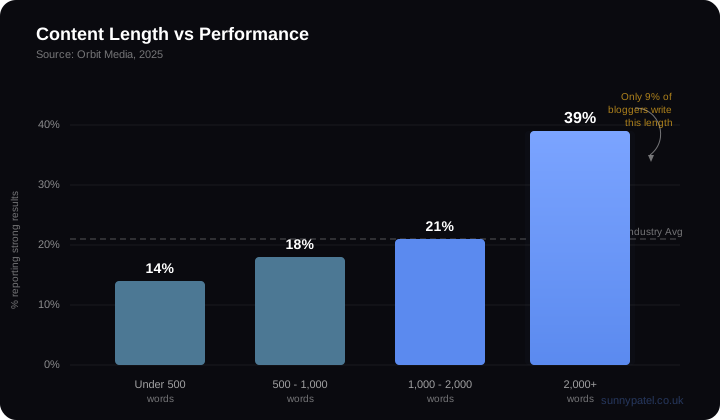
Word count target — based on SERP analysis, not arbitrary. Some queries reward 600 words. Others require 2,500. The brief specifies the appropriate length based on what currently ranks.
How Does a Content Brief Improve Rankings?
Content briefs improve rankings through three mechanisms.
Semantic coverage — specifying the entities, questions, and related terms that must appear ensures content covers the topic comprehensively enough to establish topical relevance. This is the core principle of semantic SEO. Thin content addressing only the primary keyword ranks far below comprehensive content demonstrating genuine topic understanding.
Intent alignment — briefs ensure content type matches intent. An informational query answered with a sales-focused page confuses Google's intent matching and fails to serve users. A brief specifying intent prevents this mismatch.
Consistent quality — briefs enable content production at scale without quality degradation. One writer or ten — every brief-driven piece meets the same strategic requirements.
Can You Write Good Content Without a Brief?
Experienced SEO writers can produce ranking content without formal briefs. They perform the brief research themselves as they write. The brief formalises and externalises that research. It makes the process auditable, repeatable, and scalable.
Briefs are essential for businesses using freelancers or content teams. The person writing the content gets the strategic context needed to make it effective — not just accurate or readable.
How Much Does a Content Brief Cost?
My content brief service starts from £150 per brief. Each brief includes full SERP analysis, semantic entity mapping, heading structure, question extraction, and internal linking specifications — everything a writer needs to produce ranking content without further guidance.
Compare the brief cost to the cost of content that doesn't rank — writer fees, publishing time, and hosting. The brief is the highest-ROI investment in your content process.
Free Content Brief Template
A content brief template gives your team a repeatable framework for every piece of content you produce. Below is the content brief template I use for client engagements — adapted from hundreds of briefs that have produced ranking content across competitive niches. Each field serves a specific strategic purpose.
1. Target keyword — The primary query this content is built to rank for. One keyword per brief. If you're targeting multiple related queries, that's handled through semantic coverage, not by cramming keywords into the target field.
2. Secondary keywords — 5-15 related queries and long-tail variations that should appear naturally throughout the content. These are extracted from SERP analysis and keyword research — not guessed.
3. Search intent classification — Informational, commercial, transactional, or navigational. This single field determines the entire content format. Get intent wrong and nothing else in the brief matters.
4. Word count target — Based on SERP analysis of the top 10 results, not an arbitrary number. If the top results average 1,800 words, your target should be 1,800-2,200 — not 500 and not 5,000.
5. H2/H3 outline — The complete heading structure the writer should follow. Each H2 represents a major section; H3s break down subtopics within each section. This outline is built from competitor analysis and gap identification.
6. Competing URLs to analyse — 3-5 URLs currently ranking in the top 10. The writer should read these to understand the baseline quality and identify opportunities to go deeper or cover angles competitors miss.
7. Semantic entities to cover — People, places, concepts, products, and terminology that establish topical relevance. These come from entity extraction tools and manual SERP analysis. Including the right entities is the core mechanism of semantic SEO.
8. Questions to answer — Pulled from People Also Ask, competitor headings, and forum research. Each question answered is a potential featured snippet and a signal of comprehensive coverage.
9. Internal linking targets — Specific pages on your site to link to, with suggested anchor text. This ensures every piece of content strengthens your internal linking architecture deliberately.
10. CTA (call to action) — What should the reader do after consuming this content? Subscribe, contact, purchase, read a related guide? Define this upfront so the writer crafts the content to lead naturally towards it.
11. Tone and style notes — Brand voice guidelines, reading level, whether to use first person or third person, and any specific formatting requirements (tables, comparison boxes, FAQ sections).
Use this content brief template as your starting point and adapt it to your workflow. If you need professionally researched briefs built from real SERP data rather than templates, explore my content brief service.
Content Brief Examples
Here's a practical content brief example for a fictional article targeting "best coffee grinders" — showing how each template field translates into actionable writer guidance.
Target keyword: best coffee grinders
Secondary keywords: best coffee grinder for espresso, burr grinder vs blade grinder, coffee grinder reviews 2026, best manual coffee grinder, electric coffee grinder for pour over
Search intent: Commercial investigation — the user is comparing options before purchasing. Content should be a detailed comparison guide with product recommendations, not a sales page.
Word count target: 2,200-2,800 words (based on top 10 SERP average of 2,400 words)
H2 outline:
- H2: How We Tested Coffee Grinders (methodology establishes E-E-A-T)
- H2: Best Coffee Grinders at a Glance (comparison table for scanners)
- H2: Best Overall Coffee Grinder (top pick with detailed review)
- H2: Best Budget Coffee Grinder (under £50 pick)
- H2: Best Coffee Grinder for Espresso (grind consistency focus)
- H2: Burr vs Blade Grinders — Which Type Should You Buy?
- H2: What to Look for in a Coffee Grinder (buying guide section)
- H2: Coffee Grinder FAQ
Competing URLs: [Top 5 currently ranking URLs would be listed here]
Semantic entities: burr grinder, conical burr, flat burr, grind size settings, microns, dosing, retention, single-dose grinder, hopper capacity, RPM, static, Baratza, Comandante, Fellow, 1Zpresso, James Hoffmann
Questions to answer: What's the difference between burr and blade grinders? How much should I spend on a coffee grinder? Do expensive grinders make better coffee? What grind size for espresso/pour over/French press? How often should you clean a coffee grinder?
Internal links: Link to "best espresso machines" guide (anchor: "pair it with the right espresso machine"), link to "coffee brewing methods" article (anchor: "grind size varies by brewing method")
CTA: Encourage readers to check current prices via affiliate links; secondary CTA to sign up for the newsletter for updated picks.
Tone: Authoritative but approachable. First person plural ("we tested"). Include specific measurements and test results, not just opinions.
This example demonstrates why a content brief template produces better content than a simple topic assignment. The writer receives everything needed to produce a comprehensive, intent-matched, entity-rich article — without needing to perform the research themselves.
Related Articles
- How to Build Topical Authority — content briefs are the execution layer for topical authority
- What is Semantic SEO? — the methodology that content briefs are designed to implement
- How Many Keywords Should I Target? — why briefs focus on topic coverage, not keyword count
- Increase Organic Traffic — how proper briefs translate to measurable traffic growth
Contact me to discuss brief creation for your next content sprint.