
Most SEO campaigns chase individual keyword rankings. Topical authority campaigns change the rules. Build topical authority correctly and you rank for hundreds of keywords you never directly targeted. Those rankings hold against competition that would ordinarily displace you. Here is the exact semantic SEO methodology I use with clients.
What is Topical Authority and Why Does It Matter?
What is topical authority? Topical authority is a ranking state where search engines recognise a website as the most comprehensive and reliable source on a specific subject. It is measured through the formula: Historical Data × Topical Coverage ÷ Cost of Retrieval. Sites maximising coverage whilst minimising technical friction build authority that compounds over time.
Once topical authority is established, new content you publish in that topic ranks faster, with less effort, and holds positions longer. Competitors who haven't built the same authority cannot easily displace those rankings. It creates a compounding advantage that individual keyword optimisation cannot replicate. Across my portfolio of 45 managed sites, sites with complete topical coverage consistently outrank higher-DR competitors — one site with DR 7 outranks DR 50+ competitors for 150+ keywords through topical authority alone.
Step 1 — Define Your Topical Scope
Topical authority requires focus. Build it within a defined subject area — not across an entire industry. Identify the precise topic boundary where you want to be recognised as the definitive source.
A medical aesthetics clinic might focus on: non-surgical facial treatments in a specific geography. A SaaS company might focus on: project management for remote engineering teams. Keep the scope narrow enough to achieve comprehensive coverage with realistic content resources. Keep it broad enough to contain commercial value.
Define your topical scope in three steps. List your three highest-revenue service areas. Identify the one where you have the deepest expertise and the least competitive content landscape. Start there. Expand once authority is established.
Step 2 — Build a Topical Map
What is a topical map? A topical map is a strategic document identifying every query your target audience asks within your defined topic area. It organises those queries into clusters showing relationships between topics. It becomes the blueprint for your entire content strategy.
A complete topical map contains three levels:
Root topics — the broad categories within your subject area (e.g., "facial fillers", "skin rejuvenation", "anti-ageing treatments").
Node topics — the subtopics within each root capturing mid-level queries (e.g., "cheek filler", "lip filler", "jawline filler").
Seed topics — the specific questions and long-tail queries within each node (e.g., "how long does cheek filler last", "cheek filler vs implants", "cheek filler aftercare").
A properly structured topical map typically contains 30-80 content pieces per topic cluster. In one case study, mapping just 45 articles across 3 clusters generated over 67,000 AI search citations. My topical map creation service identifies 40+ ranking opportunities competitors typically miss by analysing the full query network — not just obvious head terms.
Step 3 — Prioritise Content by Cluster
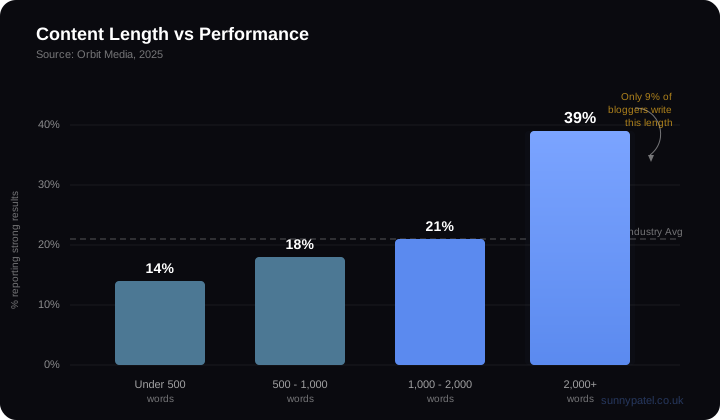
Build one cluster to near-completion before starting the next. Do not publish content in random order. Search engines interpret cluster completion as topical depth. A site with 15 comprehensive articles on one subtopic demonstrates more authority than a site with 50 shallow articles spread across 50 subtopics.
Publish hub pages first — root and node level content. Add support pages second — seed level content linking back to the hub. This architecture distributes authority toward the pages you want ranking for commercial queries.
Step 4 — Write for Comprehensive Coverage
Each piece of content should exhaust the subtopic it covers. Ask every question a reader might have about that specific topic. Address adjacent concerns. Provide context useful to readers at every knowledge level.
This approach produces content that naturally ranks for dozens of related queries — not just one target keyword. It demonstrates the kind of comprehensive expertise that topical authority requires, strengthening the entity SEO signals search engines use to evaluate your site's credibility. My content brief service provides writer-ready specifications that capture this comprehensiveness systematically.
Step 5 — Build Your Internal Linking Architecture
Internal links distribute topical authority signals across your site. They communicate which pages are most important within each cluster. Every support page should link back to its hub. Hub pages should link to related hubs. Conversion pages should receive links from the most authoritative content in each cluster.
What is a hub and spoke internal linking structure? A hub and spoke structure organises content around a central hub page — the definitive guide on a topic. Spoke pages cover subtopics and link back to the hub. The hub concentrates authority whilst spoke pages capture long-tail queries.
My internal linking strategy service maps the optimal link architecture for your existing and planned content.
Step 6 — Publish Consistently and Track Progress
Consistent publication momentum builds topical authority. A site publishing two quality articles per week for six months builds significantly more authority signal than one publishing ten articles in a burst then going quiet. Search engines interpret publication velocity as sustained expertise.
Track progress through: keyword ranking reports covering the full cluster (not just head terms), impressions growth in Google Search Console, and the percentage of your topical map covered by indexed, ranking content.
How Long Does Building Topical Authority Take?
Low-competition niches show initial authority signals within 3–6 months. Medium competition requires 6–12 months for meaningful authority. High competition demands 12–24 months for dominant authority. These timelines assume consistent, quality publication. Sporadic efforts reset momentum and extend timelines significantly. In practice, sites following this methodology see initial ranking improvements within 3-4 months, with significant authority signals emerging at 6-9 months.
Clients following this methodology consistently achieve 150–280% traffic increases within 6–9 months of campaign launch.
Related Articles
- What is Entity SEO? Build Your Digital Identity for Google — entity authority is the foundation for topical authority
- Topical Authority vs Domain Authority: Which Matters More? — why topical coverage beats link metrics
- What is E-E-A-T in SEO? — how experience and expertise signals reinforce authority
- What is a Content Brief? — the document that ensures each piece builds topical depth
I will identify your topical scope, map the opportunity, and create the content architecture that builds authority systematically. Contact me for a free consultation.