
Key SEO Statistics for 2026 (Quick Reference)
The most important figures from the data below:
- Organic search drives 53.3% of all website traffic — more than paid, social, and direct combined
- Average SEO ROI across all industries: 825% (First Page Sage)
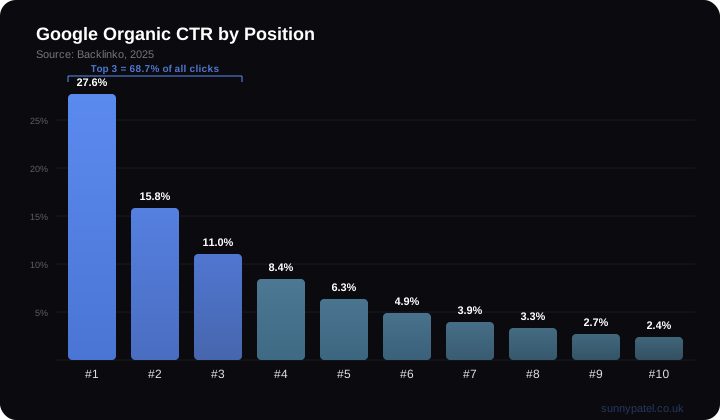
- Position 1 on Google captures 27.6% of clicks; page two gets just 0.63%
- SEO leads close at 14.6% — vs 1.7% for outbound (cold calling, direct mail)
- SEO generates leads at 61% lower cost than paid search
- 58.5% of Google searches now end with zero clicks (SparkToro)
- Only 49.7% of mobile sites pass Core Web Vitals
- 46% of all Google searches have local intent
- AI referral traffic grew 778% YoY but remains ~1% of total web traffic
- Brands cited in Google AI Overviews earn 35% more organic clicks
Organic search drives 53.3% of all website traffic globally, making it the single largest source of measurable web traffic across every industry (Source: BrightEdge, 2025). For UK businesses weighing up where to invest their marketing budgets, that number alone should reshape priorities. But it is only the starting point. The statistics below cover SEO market growth, return on investment by sector, click-through rates by ranking position, the emerging impact of AI search, content marketing benchmarks, and technical SEO fundamentals. Every figure is sourced from published research so you can verify the data and use it to build a business case for SEO investment.
SEO Market Size & Growth
The global SEO services market reached $92.74 billion in 2025 and is projected to grow to $108.28 billion in 2026, representing a 16.8% compound annual growth rate (Source: The Business Research Company). That growth reflects increasing recognition among businesses worldwide that organic search visibility is not optional — it is a core revenue channel.
Google processes over 8.5 billion searches per day, commanding 90.15% of global search engine market share (Source: Statcounter, DemandSage). In the UK specifically, Google's share is even higher, hovering around 92% according to Statcounter data. Bing holds approximately 3.5% of UK market share, though its growing AI integration — particularly through Copilot and AI-powered answers — is shifting how users interact with search results.
SEO drives 1,000%+ more traffic than organic social media (Source: BrightEdge). This disparity is critical for UK businesses allocating resources between channels. While social media has visibility and brand-building value, the volume of qualified traffic from organic search dwarfs what even large social followings generate. Businesses serious about sustainable lead generation consistently find that semantic SEO delivers compounding returns that social algorithms cannot match.
The UK digital advertising market was valued at over $30 billion in 2025, yet organic search remains the channel with the longest-lasting returns. Paid search stops delivering the moment you stop spending. SEO compounds.
SEO ROI Statistics
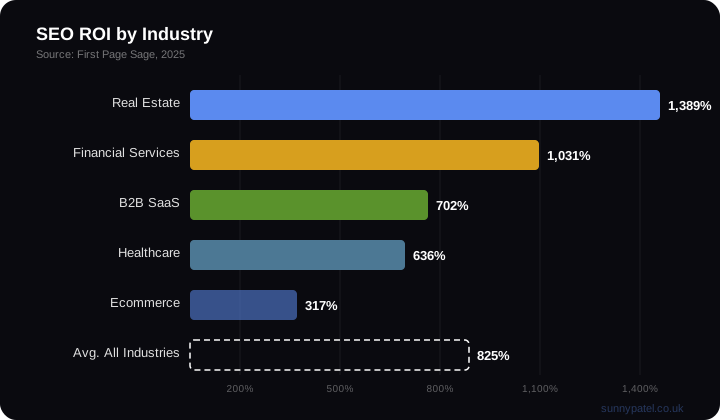
The average ROI across all verticals for SEO is 825% (Source: First Page Sage). That figure represents the median return when accounting for agency fees, content production costs, and technical implementation against the revenue generated through organic search traffic over a three-year period.
Industry-specific ROI varies significantly:
| Industry | Average SEO ROI | Timeframe |
|---|---|---|
| Real Estate | 1,389% | 3 years |
| Financial Services | 1,031% | 3 years |
| Medical Devices | 1,183% | 3 years |
| B2B SaaS | 702% | 3 years |
| Higher Education | 994% | 3 years |
| Addiction Treatment | 736% | 3 years |
| Legal Services | 526% | 3 years |
| HVAC Services | 678% | 3 years |
| E-commerce | 317% | 3 years |
(Source: First Page Sage, 2024)
The standout figure: businesses earn an average of $22 in revenue for every $1 spent on SEO (Source: SeoProfy). Compare this with PPC, where the typical return is $2 for every $1 spent on Google Ads.
SEO leads convert at a 14.6% close rate compared to just 1.7% for outbound leads such as direct mail or cold calling (Source: First Page Sage). This makes organic search the highest-converting lead source available to most businesses. The reason is intent — someone searching for your service or product is actively looking for a solution, whereas outbound marketing interrupts people who may have no current need.
SEO generates leads at a cost that is 61% lower than paid search (Source: First Page Sage). For UK businesses operating in competitive PPC markets — legal services in London, financial advice, property — the cost-per-click on Google Ads can exceed £15-£50. Organic rankings for the same terms deliver traffic at a fraction of that cost once established.
49% of marketers report that organic search delivers the best ROI of any marketing channel (Source: HubSpot State of Marketing Report). This positions SEO ahead of paid social, email marketing, paid search, and traditional advertising in marketer sentiment data.
Understanding how much SEO costs relative to these return figures is essential for UK businesses evaluating whether to invest. The data consistently shows that SEO outperforms alternative channels on a cost-per-acquisition basis across virtually every sector.
Click-Through Rate by Position
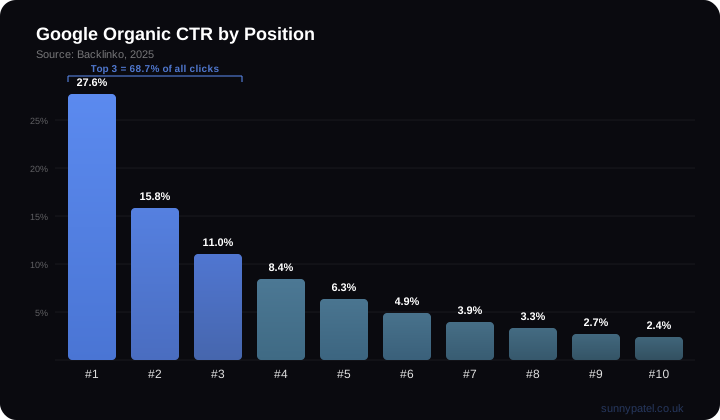
Where you rank determines how much traffic you receive. The relationship between position and clicks is not linear — it is exponential. Position one captures a disproportionate share of all clicks, and the drop-off from position one to position ten is severe.
| Google Position | Average CTR |
|---|---|
| Position 1 | 27.6% |
| Position 2 | 15.8% |
| Position 3 | 11.0% |
| Position 4 | 8.4% |
| Position 5 | 6.3% |
| Position 6 | 4.9% |
| Position 7 | 3.8% |
| Position 8 | 3.0% |
| Position 9 | 2.5% |
| Position 10 | 2.1% |
(Source: Backlinko, 2024)
The top three results capture 68.7% of all clicks on a search results page. Page two — positions 11 and beyond — receives just 0.63% of clicks (Source: Backlinko). The practical implication is stark: if your page ranks on page two of Google, it is functionally invisible to searchers.
Featured snippets, when present, capture approximately 8.6% of clicks and can cannibalise position one's CTR. Rich results including FAQ markup, review stars, and how-to schema increase CTR by as much as 30% compared to plain blue link results (Source: Sixth City Marketing).
These figures explain why incremental ranking improvements — moving from position eight to position three, for example — produce transformative traffic increases. A page receiving 1,000 impressions per month at position eight (3.0% CTR = 30 clicks) would receive 110 clicks at position three. That is a 267% increase from moving just five positions.
My approach to on-page SEO and keyword research focuses specifically on identifying where these incremental gains are achievable with the least effort. Not every keyword needs to reach position one. Moving from page two to mid-page-one often delivers the highest ROI.
AI Search Impact on SEO
AI is reshaping search behaviour, but the data tells a more nuanced story than many headlines suggest. Understanding what the numbers actually show — rather than reacting to speculation — is critical for making sound SEO investment decisions.
Google's AI Overviews now appear in approximately 13% of US desktop search queries (Source: Search Engine Land, 2025). The percentage varies significantly by query type, with informational and health-related queries triggering AI Overviews most frequently, while transactional and navigational queries remain largely unaffected.
For queries where AI Overviews do appear, organic click-through rates dropped by 61% (Source: Seer Interactive). This is a significant figure, but context matters: AI Overviews affect a subset of queries, not all search. The overall impact on organic traffic for most sites remains modest.
58.5% of Google searches now end with zero clicks — meaning the user finds their answer directly on the search results page without visiting any website (Source: SparkToro, Datos). This figure includes searches resolved by featured snippets, knowledge panels, People Also Ask boxes, and AI Overviews. It represents a continuation of a trend that predates generative AI, but AI Overviews are accelerating it.
ChatGPT has reached 800 million weekly active users and processes approximately 2 billion queries per day (Source: DemandSage, 2025). This makes it a meaningful search alternative, though still a fraction of Google's 8.5 billion daily searches.
AI referral traffic — visits to websites originating from AI tools like ChatGPT, Perplexity, and Claude — grew 778% year-over-year (Source: Similarweb). Despite this dramatic growth rate, AI still accounts for only approximately 1% of total web traffic (Source: BrightEdge). The percentage is growing, but the base remains small.
A critical finding for SEO strategy: only 12% of URLs cited by AI tools currently rank in Google's top 10 results (Source: The Digital Bloom). This means AI systems are selecting different content than Google's traditional algorithm in many cases. Content that ranks well in Google is not automatically the content that AI systems choose to cite.
However, brands that are cited in Google's AI Overviews earn 35% more organic clicks than brands that are not cited (Source: Seer Interactive). Being present in AI-generated answers acts as a trust signal that increases, rather than cannibalises, overall click-through rates for the cited brand.
What this means for UK businesses: optimising content for AI search is becoming a parallel discipline to traditional SEO. The content characteristics that AI systems favour — structured data, clear entity definitions, authoritative sourcing, and comprehensive topical coverage — align closely with the principles of semantic SEO and E-E-A-T. Businesses investing in these fundamentals are positioned for both traditional and AI-driven search.
Content Marketing & SEO Statistics
Content remains the mechanism through which SEO delivers results. The statistics around content marketing effectiveness reinforce why systematic content production — not sporadic publishing — drives organic growth.
82% of businesses now actively use content marketing as part of their strategy (Source: Typeface, 2025). The channel is no longer experimental. It is a baseline expectation, which means the quality bar for content that actually ranks is higher than ever.
85.19% of blog traffic comes from organic search (Source: SeoProfy). Social shares and direct visits account for a small minority. This confirms that blog content is primarily an SEO asset. Writing content without an SEO strategy behind it — without targeting specific queries, building topical authority, and implementing proper internal linking — wastes the vast majority of its traffic potential.
Long-form content consistently outperforms shorter articles. Posts of 2,000+ words generate strong results for 39% of bloggers who publish at that length, compared to 21% reporting strong results across all content lengths (Source: Orbit Media Survey, 2024). Despite this, only 9% of bloggers consistently create content of 2,000+ words (Source: Orbit Media). This gap between what works and what most businesses publish represents a significant competitive opportunity.
Blog and SEO content was ranked the number one ROI channel for B2B marketers (Source: HubSpot, 2025). For UK B2B companies — consultancies, SaaS providers, professional services — this positions content-led SEO as the primary growth lever.
The average first-page ranking result on Google contains approximately 1,447 words (Source: Backlinko). This does not mean word count is a ranking factor. It reflects the reality that comprehensive content covering a topic thoroughly tends to satisfy search intent more completely than thin content.
Using content briefs to plan content before production ensures every piece targets the right queries, covers the right entities, and supports the broader topical map. The difference between content that ranks and content that sits on page four is almost always strategic planning, not writing quality alone.
Effective internal linking amplifies content performance by distributing authority across topic clusters and helping search engines understand the relationship between pages. Sites with structured internal linking strategies see measurably faster indexation and stronger rankings for supporting content.
Technical SEO Statistics
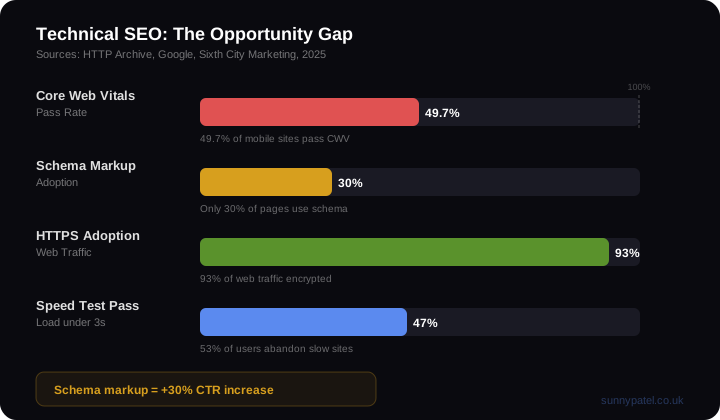
Technical SEO forms the foundation that content and authority are built upon. The statistics below reveal how many sites fail to meet basic technical standards — and the direct impact on traffic and conversions.
Only 49.7% of mobile websites pass Google's Core Web Vitals assessment (Source: HTTP Archive, 2025). This means more than half of all mobile sites fail to meet Google's own performance thresholds. For UK businesses competing for mobile traffic — which constitutes the majority of searches — failing Core Web Vitals is a measurable ranking disadvantage.
The probability of a user bouncing increases by 32% when page load time goes from one second to three seconds (Source: Google). A one-second delay in page load reduces conversions by approximately 20% (Source: Google). And 53% of mobile users abandon sites that take longer than three seconds to load (Source: Google).
These are not abstract metrics. For an e-commerce site generating £100,000 per month, a one-second load delay translates to roughly £20,000 in lost monthly revenue. A technical SEO audit identifies exactly where these performance bottlenecks exist and how to resolve them.
64.35% of all web traffic now comes from mobile devices (Source: Statista, 2025). Google's mobile-first indexing means the mobile version of your site is the version Google evaluates for rankings. Desktop-first design with mobile as an afterthought is no longer viable.
Schema markup (structured data) can increase click-through rates by up to 30% through rich results like review stars, FAQ dropdowns, and event listings (Source: Sixth City Marketing). Despite this documented benefit, only approximately 30% of pages across the web implement any form of structured data. This represents another gap between best practice and common practice that UK businesses can exploit. My guide on semantic markup for SEO covers implementation in detail.
HTTPS adoption has reached 95%+ among top-ranking sites. Google confirmed HTTPS as a ranking signal in 2014, and sites still serving pages over HTTP face both ranking penalties and browser security warnings that destroy user trust.
27% of sites across the web have duplicate content issues that dilute ranking signals (Source: SEMrush Site Audit data). Canonical tag implementation, proper URL parameter handling, and structured site architecture prevent these problems from undermining otherwise strong content.
Local SEO Statistics
For UK businesses serving specific geographic areas, local SEO statistics demonstrate the immediate commercial impact of local search visibility.
46% of all Google searches have local intent (Source: Google). Nearly half of all search activity involves someone looking for something nearby — a service, a shop, a restaurant, a professional. For businesses in Reading, Berkshire, Slough, Bracknell, Maidenhead, or Wokingham, this means local search is not a niche tactic — it is where nearly half your potential customers begin.
76% of people who search for something nearby on their phone visit a related business within a day (Source: Google). 28% of those searches result in a purchase. Local search intent translates to real-world revenue faster than almost any other digital marketing channel.
Google Business Profile listings with complete information are 70% more likely to attract location visits and 50% more likely to lead to a purchase (Source: Google). Completing and optimising your profile is one of the highest-impact, lowest-cost SEO activities available.
87% of consumers used Google to evaluate local businesses in 2024 (Source: BrightLocal). Reviews, photos, opening hours, and service descriptions on your Google Business Profile directly influence whether potential customers choose you or a competitor.
For businesses in Berkshire and the surrounding area, my local SEO guide for Berkshire covers the specific strategies that drive results in this region. Local SEO services focus on the signals that move the needle for geographically targeted businesses.
What These Statistics Mean for UK Businesses
These statistics are not academic. They translate directly into strategic decisions for UK businesses:
SEO delivers the highest ROI of any digital marketing channel. The 825% average return, 14.6% lead close rate, and 61% lower cost per lead compared to paid search make the financial case unambiguous. Businesses not investing in SEO are leaving their highest-return channel untapped. My semantic SEO services are built around maximising this return through structured, entity-based optimisation.
Ranking position determines everything. The 68.7% of clicks captured by the top three results means that ranking on page one is not enough — you need to be in the top three. Moving from position eight to position three can increase traffic by over 250% for the same keyword. This is why keyword research that accounts for intent, competition, and realistic positioning matters more than chasing high-volume vanity terms.
Technical foundations are non-negotiable. With more than 50% of mobile sites failing Core Web Vitals and a 20% conversion drop per second of delay, technical performance directly impacts revenue. A technical SEO audit is the starting point for any serious SEO investment.
AI search is an opportunity, not a threat. The 778% growth in AI referral traffic and the finding that brands cited in AI Overviews earn 35% more organic clicks suggest that AI search amplifies well-optimised, authoritative content rather than replacing it. The businesses that will benefit most are those building topical authority and E-E-A-T signals now.
Content quality and consistency compound. With 85% of blog traffic coming from organic search and 2,000+ word content outperforming shorter alternatives, the investment in comprehensive, strategically planned content pays dividends over years, not weeks. Understanding how long SEO takes sets realistic expectations for the timeline. Understanding how much SEO costs helps you budget appropriately for the investment.
The opportunity gap is real. Only 9% of businesses consistently publish long-form content. Only 30% implement schema markup. More than 50% fail Core Web Vitals. These gaps mean that businesses willing to execute on the fundamentals — consistently and systematically — face less competition than the raw market size suggests.
Sources
- BrightEdge — Organic Search Share of Traffic — 53.3% organic traffic share, 1,000%+ more than social, AI traffic data
- The Business Research Company — SEO Services Market Report — $92.74B market size, 16.8% CAGR
- Statcounter — Search Engine Market Share — 90.15% Google global market share
- DemandSage — Google Search Statistics — 8.5B daily searches, ChatGPT usage data
- First Page Sage — SEO ROI Statistics — 825% average ROI, industry-specific ROI, 14.6% close rate, 61% lower CPL
- SeoProfy — SEO Statistics — $22 per $1 spent, 85.19% blog traffic from organic
- HubSpot — State of Marketing Report — 49% marketers report best ROI from organic search, B2B channel rankings
- Backlinko — Google CTR Statistics — Position-by-position CTR data, top 3 capture 68.7%
- Search Engine Land — AI Overviews — 13% AI Overview appearance rate
- Seer Interactive — AI Overviews CTR Impact — 61% CTR drop with AI Overviews, 35% more clicks for cited brands
- SparkToro / Datos — Zero-Click Searches — 58.5% zero-click rate
- Similarweb — AI Referral Traffic — 778% YoY AI referral growth
- The Digital Bloom — AI Citation Study — 12% URL overlap between AI citations and Google top 10
- Typeface — Content Marketing Statistics — 82% of businesses use content marketing
- Orbit Media — Blogging Survey — 2,000+ word performance data, 9% long-form adoption
- HTTP Archive — Core Web Vitals — 49.7% mobile CWV pass rate
- Google — Page Speed Impact Data — Bounce rate, conversion, and abandonment statistics
- Statista — Mobile Traffic Share — 64.35% mobile web traffic
- Sixth City Marketing — Schema Markup CTR — 30% CTR increase from structured data
- Google — Local Search Statistics — 46% local intent, 76% same-day visits, 28% purchase rate
- BrightLocal — Local Consumer Review Survey — 87% use Google to evaluate local businesses
Related Articles
- How Long Does SEO Take? — realistic timelines backed by data
- What is E-E-A-T in SEO? — quality signals that drive these statistics
- How to Build Topical Authority — the strategy behind top-ranking content
- Optimise Content for AI Search — preparing for the AI search shift
These statistics make the case. The question is whether your business is capturing its share of the 8.5 billion daily searches or leaving that traffic to competitors. If you want a data-driven assessment of where your site stands and what SEO could deliver for your specific market, speak to an experienced SEO consultant in Reading or get in touch to discuss your situation.