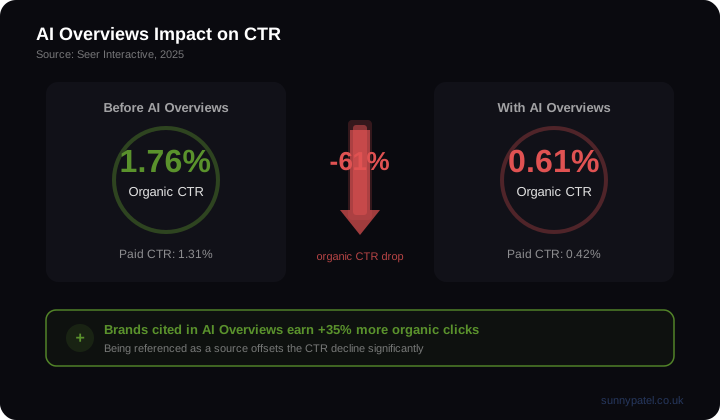
AI search is now the default experience for millions of queries daily. Bing Copilot, ChatGPT Search, Perplexity, and Google AI Overviews — all forms of generative engines — generate answers from your content. They do not always send traffic to your site. Optimising for AI search means getting cited in those answers. In February 2026, a cross-platform audit of my portfolio revealed 120,000+ Bing AI Copilot citations across 11 sites — a 57:1 ratio of AI citations to organic clicks. Content optimised for AI search generates visibility at scale.
What Does Optimising for AI Search Mean?
What is AI search optimisation? AI search optimisation is the practice of structuring content so that large language models (LLMs) select it as a source when generating answers to user queries. This overlaps with LLM optimisation — the broader discipline of making content visible to AI systems. It overlaps with traditional SEO but prioritises direct answerability, factual precision, and entity credibility over keyword density.
Why Traditional SEO Is Not Enough for AI Search
Traditional SEO earns ranking positions. AI search citations work differently. The model selects the most directly useful source from its retrieval pool — not necessarily the highest-ranking one.
A page at position 6 with a clear, structured answer frequently outperforms a position 1 page with narrative-heavy content. Content optimised purely for ranking signals misses AI citations entirely. Address both in your content strategy.
7 Content Patterns That Earn AI Citations
1. Answer First, Context Second
AI models extract the most direct answer to a query. Restructure every section so the answer appears in the first sentence. Add supporting context after. The inverted pyramid format works well here — state the conclusion first, then explain it.
2. Use Explicit Question-Answer Formatting
Sections opening with a bolded question followed immediately by a definition sentence appear consistently in AI-generated answers. Format: What is [term]? [One-sentence definition.] This mirrors how models retrieve factual content and makes extraction unambiguous.
3. Include Specific Data Points
Vague claims don't get cited. Specific, verifiable figures do. Replace "most businesses see improved traffic" with "average traffic increases of 150–280% within 6–9 months." Named statistics with attributed sources perform best. AI models treat specificity as a credibility signal. The highest-cited content in my portfolio — a technical troubleshooting guide — earned over 31,000 AI citations alone. Research-backed, evidence-based content with specific data points consistently outperforms opinion pieces.
4. Cover Related Questions in One Page
AI models prefer comprehensive sources addressing multiple facets of a topic. A page answering the primary query plus four related questions outperforms four separate pages. The model extracts multiple pieces of information from one trusted source. This aligns with topical authority principles — comprehensive coverage signals genuine expertise.
5. Use Clean HTML Structure
Clear heading hierarchies (H1 → H2 → H3), short paragraphs (2–3 sentences), and bulleted lists all improve AI extractability. Models parse HTML structure to understand content organisation. A well-structured page is far easier to cite accurately than a wall of text with inconsistent formatting.
6. Establish Entity Credibility
What is entity credibility in SEO? Entity credibility is the degree to which search engines and AI models recognise your brand, person, or organisation as an authoritative source on a specific topic. Sites with strong entity signals receive citation preference. The model has higher confidence in information from a recognised, credible entity.
Building entity credibility requires consistent publication in your topic area, structured data markup identifying your entity, and mentions from established sources. Sites with complete Person schema, Organization schema, and sameAs consolidation across platforms receive measurably higher AI citation rates than sites without entity markup. Entity SEO is the discipline focused on building these signals systematically. My semantic SEO service specifically addresses entity establishment as a foundation for AI search visibility.
7. Match Content to the Exact Query
AI models retrieve content to answer specific queries — not broad topics. Use keyword research to identify the precise questions your audience types. Create dedicated sections answering each one. Closer content-to-query matching increases citation probability.
How to Track AI Search Performance
Bing Webmaster Tools provides Copilot citation data. It shows which pages receive AI citations and for which queries. Google Search Console does not yet provide equivalent data for AI Overviews.
Monitoring citation patterns in Bing gives the clearest current picture of AI search performance. It reveals which content patterns work in your specific niche.
Related Articles
- What is LLM Optimisation? — the technical framework behind AI content visibility
- Generative Engine Optimisation (GEO) — the broader strategy for AI search presence
- What is Entity SEO? — why entity credibility determines AI citation selection
- What is E-E-A-T in SEO? — the quality signals AI models evaluate when choosing sources
I review content structure, entity signals, and query coverage as part of a full site audit. Contact me for a free consultation to identify where your pages are missing AI citation opportunities.