On 9 February 2026, OpenAI began showing paid advertisements inside ChatGPT. Not rumours. Not a roadmap slide. Live, labelled sponsored units appearing below responses for millions of free users in the United States. The interface that trained an entire generation of people to expect unbiased, unconflicted answers now has a revenue model built around brand spend. If you work in marketing, run a website, or care about how AI systems decide what to recommend, this changes things. Here is everything confirmed so far — and what you should be doing about it.
What OpenAI Has Actually Announced
OpenAI published two official statements: a blog post on 16 January 2026 setting out its philosophy, and a testing announcement on 9 February 2026 confirming the rollout had begun.
The key facts from those documents:
- Ads are live in the United States for users on the Free and Go tiers (Go is a new $8/month plan that sits below the existing Plus tier)
- Plus, Pro, Business, Enterprise, and Education subscribers will not see ads
- Ads appear as a clearly labelled, visually separated unit below ChatGPT's organic response — not embedded within it
- OpenAI states explicitly that ads do not influence the answers ChatGPT provides
- Conversations remain private from advertisers; no chat history, name, email, precise location, or IP address is shared
- Users under 18 will not see ads
- Ads will not appear alongside content about politics, health, or mental health
Free users who do not want ads can opt out — but at the cost of fewer daily free messages.
Who Is Advertising, and What Does It Cost?
This is not a self-serve platform open to any business. The initial pilot is an enterprise product. According to Adweek and MediaPost, the first-wave partners are the three largest agency holding groups: Omnicom Media, WPP, and Dentsu. Omnicom alone confirmed more than 30 clients have secured placements. Named early advertisers include Mercedes-Benz, JPMorgan Chase, Estée Lauder, Adobe, Expedia, and Best Buy.
Pricing sits at $60 CPM (cost per thousand impressions) with a $200,000 minimum commitment. This is premium territory — comparable to high-impact digital display, well above Google Search CPMs. For now, this is a large-brand beta. Small and mid-size businesses are not yet in scope.
OpenAI projects approximately $1 billion in revenue from free-user monetisation in 2026.
What the Ad Format Actually Looks Like
Two formats have been confirmed during the test:
Shopping product carousel — a scrollable row of products with pricing, images, and a direct checkout integration via Etsy and Shopify. Appears in response to purchase-intent queries.
Conversational banner — a branded unit that allows users to ask ChatGPT questions about the advertised product. The interaction stays within the chat interface.
Both formats appear below the organic answer. The sponsored label is visible. One important detail that has surprised early observers: ads now appear on a user's very first message — not after extended conversation, as many anticipated. A user who opens ChatGPT cold and asks "What's the best way to book a weekend away?" can see a sponsored Expedia unit on that immediate response.
Targeting uses the content of your current chat thread, general location and language, and (if you have opted into personalised ads) your broader interaction history with ChatGPT. Unlike Google or Meta, there are no keyword-level bidding controls — advertisers cannot target specific queries. The system matches ad context to conversation intent, which is a meaningfully different dynamic for experienced paid search practitioners.
How This Compares to Perplexity and Google
Understanding ChatGPT ads requires placing them in context. Three different AI platforms have now taken three different positions on advertising.
Perplexity tested sponsored placements throughout 2024 and early 2025, then abandoned advertising entirely in February 2026. The company's executives concluded that even clearly labelled ads risk eroding the trust that makes an AI answer engine valuable. Perplexity's model is now purely subscription-based. Anthropic has made a similar commitment — Claude will not carry ads.
Google runs ads within AI Overviews and AI Mode in Search, but not inside Gemini (the standalone assistant). The Google model integrates commerce units tightly — ads can appear above, below, or within the AI-generated answer block. Google's challenge is that this approach risks cannibalising its own paid search clicks, which is the business it is defending.
OpenAI has chosen a middle path: ads are separated from the answer, explicitly labelled, and governed by a stated editorial principle that they will not shape what ChatGPT says. The revenue mechanism is impression-based (CPM), not click-based, which creates different incentives than Google's pay-per-click model.
The industry is now visibly splitting. Perplexity's exit from advertising and Claude's stated commitment to remaining ad-free set up a direct contrast with OpenAI and Google. Which model earns more user trust over time will shape how this market develops.
One Detail Every SEO Should Know
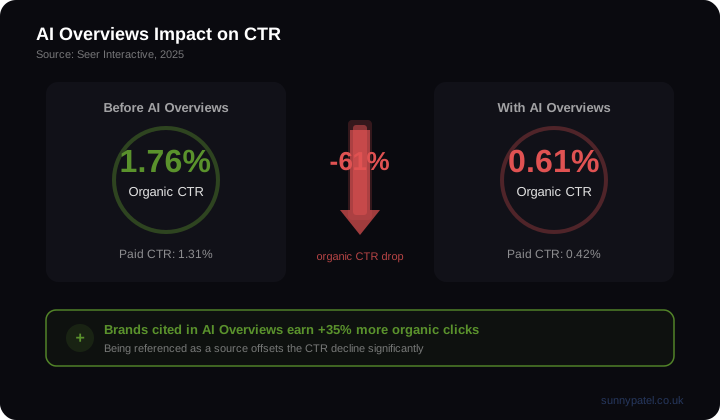
Seer Interactive published analysis tracking 206,412 ChatGPT responses across 43 brands that deserves close attention. They identified a significant algorithmic shift beginning on 1 December 2025 — 46 days before the public advertising announcement on 16 January 2026.
What changed in December:
- Citations per response increased 81%, from an average of 5.7 to 10.4
- Commercial-intent query handling shifted substantially
- 55.8% of tracked brands lost organic citation visibility before any public announcement
The implication is that OpenAI was preparing its organic infrastructure before introducing paid placements. A more citation-dense environment is a necessary precondition for a credible ad ecosystem — you need organic results to be seen as reliable before you can place paid units alongside them without them looking suspicious. That groundwork appears to have been laid in advance.
If your brand lost visibility in ChatGPT organic results in December or January, this is likely why. It also means the baseline has reset. Organic citation patterns in ChatGPT today reflect a system that was redesigned with advertising in mind.
What This Means for Organic AI Visibility
The conventional framing — that organic and paid are separate — does not hold cleanly in an AI answer interface. In traditional search, organic rankings and paid ads occupy clearly separate positions. In ChatGPT, both appear below the same conversational response, in the same approximate area of the interface. A user asking "which project management tool should I use?" will see ChatGPT's organic recommendation and then, immediately after, a sponsored unit from a tool with a $200k budget.
That adjacency changes competitive dynamics. Strong organic mentions in the AI response become more valuable, not less — because they appear in the same visual zone as advertising, and they carry the implicit endorsement of the model rather than the explicit label of a paid placement.
The brands most exposed are those with no organic presence in ChatGPT responses. They will encounter ChatGPT as a paid-only medium, subject to $60 CPM minimums. The brands best placed are those already cited organically — because their position in the answer interface predates the ad layer and is not dependent on spend.
There is a further data point that makes this urgency concrete. ChatGPT referral traffic currently converts at 5.1x the rate of standard organic traffic — users arriving via ChatGPT citations are more purchase-ready and more engaged (averaging 2.3 pages per session) than typical search visitors. That conversion quality will become the real battleground as paid placements multiply alongside organic citations.
If you are working on AI search optimisation, the ChatGPT ads launch is not a reason to stop. It is a reason to accelerate.
How to Prepare: What to Do Now
Audit Your Current ChatGPT Organic Presence
Run manual tests across your 10–15 most commercially important queries. Is your brand mentioned in the organic response? Are competitors mentioned instead? Document this as a baseline. Given the December algorithm shift, data from before that date is less relevant — re-test now.
Tools such as Otterly.ai and Profound provide structured tracking of AI citation patterns across ChatGPT, Perplexity, and Google AI Overviews, rather than relying on manual tests.
Improve Your Content's Citation Signals
The research is consistent. Content more likely to earn citations in ChatGPT shares specific characteristics:
- Pages updated within two months earn 28% more citations than older content — freshness matters
- Pages with well-organised headings are 2.8x more likely to earn citations — structure your H2s as direct questions with immediate answers in the opening sentence
- 44.2% of all LLM citations come from the first 30% of text — front-load your most citable claims
- Content with specific data, statistics, and named sources achieves 30–40% higher AI visibility than vague equivalent content
My guide to optimising content for AI search covers the seven patterns in detail. The core principle is direct answerability: the model extracts the most directly useful information from its retrieval pool. Content that buries its answer loses to content that leads with it.
Strengthen Your Entity Signals
LLMs assign citation preference to entities they recognise as credible within a topic area. This means consistent publication, structured data markup (Organisation and Person schema with sameAs consolidation), and genuine mentions from established external sources.
LLM optimisation and entity building are the organic equivalent of what advertisers are spending $200k minimums to achieve through paid placements — getting your brand name associated with relevant purchase-intent responses inside ChatGPT. The organic path takes longer. It also cannot be bought by a competitor.
What Not to Do
Do not ignore this because the $200k minimum excludes you today. The self-serve tier will come. The brands establishing organic citation presence now will have lower effective CPMs when paid placements open to smaller advertisers — because their organic mentions provide free impressions that paid placements will supplement rather than replace.
Do not assume your Google rankings transfer to ChatGPT. They partially do, but the correlation is imperfect. ChatGPT's retrieval layer weights content quality, freshness, and direct answerability more heavily than ranking position. A page at position 6 with direct answer formatting frequently outranks a position 1 page in AI citation selection.
Do not wait for clarity on publisher revenue sharing. News publishers who signed content licensing deals with OpenAI will not receive a share of advertising revenue. The licensing deals cover content access for training and retrieval — not downstream monetisation. If you were expecting a revenue relationship with OpenAI based on your content appearing in ChatGPT, that expectation is now confirmed as incorrect.
The Bigger Picture
ChatGPT is used by 800 million people weekly. It processes over 100 million conversations daily. The addition of advertising to that interface is not a marginal development. It is the moment AI search formally becomes an advertising medium — with the same implications for SEO and paid media convergence that Google's launch of AdWords had in 2000.
Perplexity's decision to abandon ads entirely is a significant counterpoint. It signals that at least one major AI platform believes trust is more valuable than CPM revenue. Whether users can actually distinguish the two — an AI that runs ads versus one that does not — will become a live question over the next 12–18 months.
OpenAI's stated expansion roadmap runs as follows: broader rollout to ChatGPT Search for English-speaking markets through mid-2026, introduction of sidebar sponsored content and affiliate features in Q4 2026, full international expansion and a self-serve advertising platform in 2027. The enterprise-only $200k minimum is temporary infrastructure — a self-serve tier for smaller advertisers is explicitly planned.
For practitioners, the practical answer is clear: organic AI visibility is not a future consideration. It is competitive infrastructure that is being built or neglected right now, while the organic citation landscape is being established and before paid placements create a new layer of complexity above it.
Related Articles
- Optimise Content for AI Search — the seven content patterns that earn citations in ChatGPT, Perplexity, and Google AI Overviews
- What is LLM Optimisation? — the technical framework for making content visible to AI systems
- AI Search Optimisation Service — how I audit and improve organic AI citation performance for clients
If you want to understand where your brand currently stands in ChatGPT organic results — and what it would take to improve that position before paid competition intensifies — get in touch for a free consultation.