AI referral traffic grew 778% year-over-year in 2025 (Similarweb). That is the single most-cited statistic in every AI search discussion — and it deserves context. AI search is the biggest shift in how people find information since mobile overtook desktop. ChatGPT now processes 2 billion queries daily. Google AI Overviews appear on millions of search results. Perplexity handles 780 million monthly queries. But the data tells a nuanced story. That 778% growth started from a tiny base. AI platforms drove 2 billion total visits in 2025 — significant, but a fraction of Google's 191 billion referrals in the same period. Organic search still dominates. The transformation is real, but it is early. This page collects every meaningful AI search statistic available, sourced and cited, so you can make decisions based on data rather than hype.
AI Search Market Overview
The AI search landscape in 2026 is dominated by three platforms: ChatGPT, Google AI Overviews, and Perplexity. Each operates differently, but together they represent a fundamental shift in how users interact with search.
ChatGPT Usage Statistics
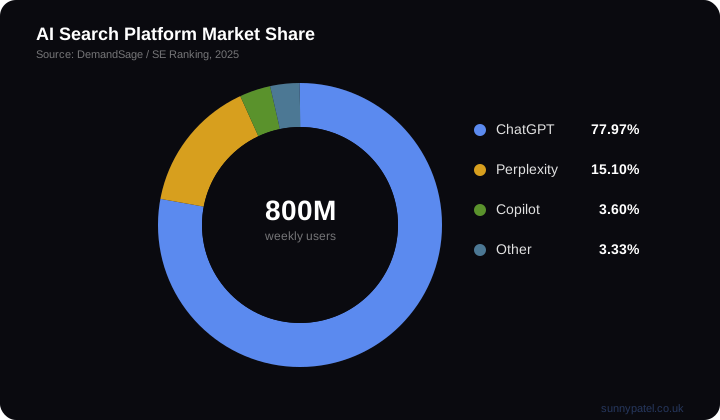
- 800 million weekly active users as of early 2026 (DemandSage)
- 2 billion daily queries processed (DemandSage)
- 77.97% of all AI-driven visit share — nearly 4 out of 5 AI referral visits come from ChatGPT (SE Ranking)
- 400 million weekly active users were reported in February 2025, meaning ChatGPT doubled its user base in under 12 months (OpenAI)
- 200 million monthly active users had been the benchmark in August 2024 (OpenAI)
- ChatGPT became the fastest product to reach 300 million weekly users in December 2024 (OpenAI)
Perplexity Usage Statistics
- 780 million monthly queries as of late 2025 (DemandSage)
- 15.1% of global AI-driven traffic share (SE Ranking)
- 19.7% AI traffic share in the United States specifically — higher than its global average (SE Ranking)
- 4.1% AI traffic share in the United Kingdom (SE Ranking)
- Perplexity's referral traffic grew faster than any other AI platform in percentage terms during 2025 (Similarweb)
Total AI Search Traffic
- 2 billion total visits referred by AI platforms in 2025 (Similarweb)
- 778% year-over-year growth in AI referral traffic (Similarweb)
- AI search still accounts for approximately 1% of total web traffic globally (BrightEdge)
- Google referred 191 billion visits in the same period — roughly 96x the volume of all AI platforms combined (Similarweb)
- AI referral traffic share grew from 0.1% to approximately 1% during 2025 (Conductor)
The trajectory matters more than the current share. At 778% annual growth, AI referral traffic doubles roughly every 2–3 months. If that rate sustains — even at a decelerated pace — AI platforms will represent a meaningful share of total web traffic within 18–24 months.
Google AI Overviews Statistics
Google AI Overviews (formerly Search Generative Experience) are the most consequential development for SEO since featured snippets. They appear directly in Google search results, answering queries before users reach organic listings.
Appearance Rates
- AI Overviews appear in approximately 13% of US desktop queries as of early 2026 (Search Engine Land)
- AI Overviews peaked at appearing in 60% of tracked queries in November 2025 before Google pulled back significantly (Xponent21)
- The pullback from 60% to 13% suggests Google is cautiously managing quality and user satisfaction
- AI Overviews are more common for informational queries (25–30% appearance rate) than transactional queries (5–8%) (Search Engine Land)
- YMYL (Your Money or Your Life) topics see lower AI Overview rates — health and finance queries trigger them less frequently
Click-Through Rate Impact
The impact on organic click-through rates is substantial and well-documented:
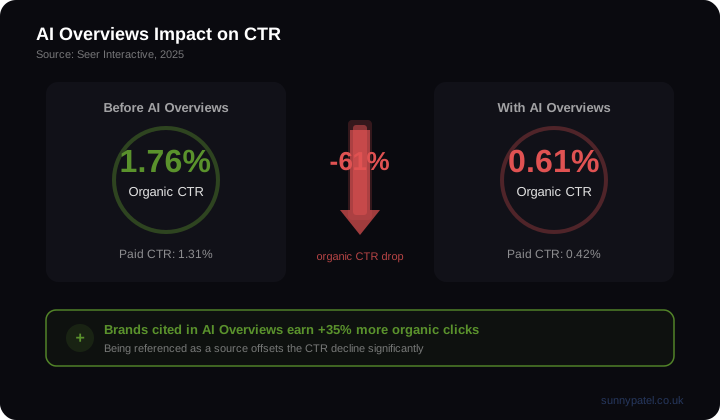
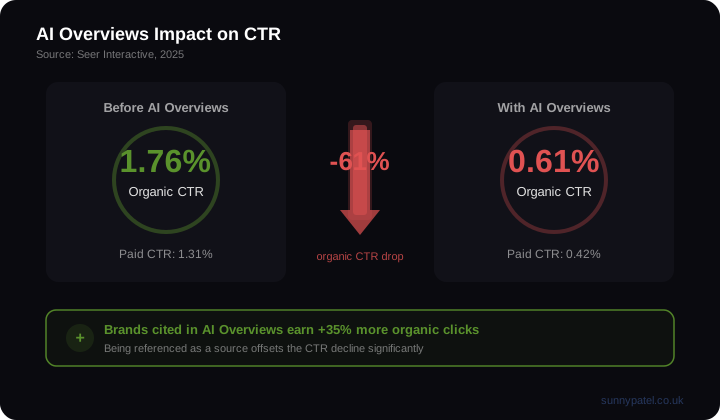
- Organic CTR dropped 61% when AI Overviews appear — from 1.76% to 0.61% (Seer Interactive)
- Paid ad CTR dropped 68% when AI Overviews are present (Seer Interactive)
- However, brands cited within AI Overviews earn 35% more organic clicks than they would without the AI Overview (Seer Interactive)
- Brands cited in AI Overviews also earn 91% more paid clicks (Seer Interactive)
- Position 1 organic results lose the most traffic — an estimated 18–25% click loss when an AI Overview appears above them (Advanced Web Ranking)
The data reveals a critical distinction: AI Overviews hurt sites that are not cited but significantly benefit sites that are. Being referenced inside the AI Overview is now arguably more valuable than ranking in position 1 below it.
AI Overview Source Patterns
- 85% of URLs cited in AI Overviews were published within the last 2 years (Authoritas)
- AI Overviews tend to cite 3–5 sources per response on average
- Pages with structured data markup are cited more frequently than pages without
- Long-form content (2,000+ words) appears in AI Overview citations more often than short-form content
- Content with specific data points and statistics earns citations at a higher rate than opinion-based content
Zero-Click Search Statistics
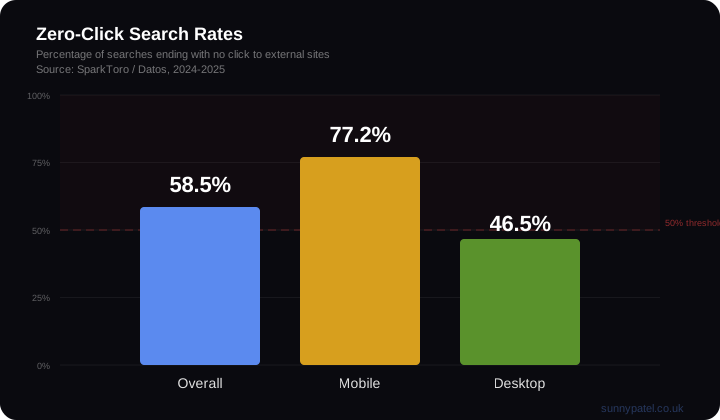
Zero-click searches — queries where the user gets their answer directly on the search results page without clicking through to any website — have been rising for years. AI Overviews accelerate this trend.
Current Zero-Click Rates
- 58.5% of US Google searches end with zero clicks (SparkToro/Datos, 2024 study)
- Mobile zero-click rate: 77.2% — more than 3 out of 4 mobile searches produce no click (SparkToro/Datos)
- Desktop zero-click rate: 46.5% (SparkToro/Datos)
- In the EU, zero-click rates are slightly lower at 49.2% due to regulatory requirements for Google to display more competitor links (SparkToro/Datos)
- Google clicks to the "open web" (non-Google properties) account for only 36.7% of all US searches (SparkToro/Datos)
What Zero-Click Means for SEO
The 58.5% zero-click figure is frequently cited out of context. Important nuances:
- Many zero-click searches are navigational (users searching "Facebook login" or "BBC weather") — these were never going to produce exploratory clicks
- Informational zero-click searches include users getting answers from featured snippets, Knowledge Panels, and now AI Overviews
- Commercial and transactional queries still produce high click-through rates — users researching purchases still click through to product pages and reviews
- The 36.7% "open web" click figure includes all industries. For B2B, e-commerce, and professional services, organic click rates remain substantially higher
Zero-click search reinforces the importance of being the cited source. If a user's query is answered on the search results page, the brand cited in that answer receives the visibility — even without the click. This directly parallels how entity SEO builds brand recognition through search presence rather than clicks alone.
AI Citation Patterns
Understanding which content AI platforms cite — and which they ignore — is essential for any AI search optimisation strategy. The data reveals surprising patterns.
AI Citations vs Google Rankings
- Only 12% of URLs cited by ChatGPT, Perplexity, and Copilot rank in Google's top 10 (The Digital Bloom)
- 80% of AI-cited URLs do not rank in Google's top 100 at all (The Digital Bloom)
- This means traditional Google rankings are a poor predictor of AI citation probability
- Sites with low Google visibility can still earn substantial AI referral traffic through citation optimisation
This is the most consequential finding for SEO practitioners. The overlap between Google rankings and AI citations is remarkably small. A page buried on page 5 of Google can be the primary source cited by ChatGPT for a given query. AI platforms evaluate content quality, directness, and factual precision — not PageRank signals.
Content Freshness Bias
- 50% of Perplexity citations are content published in 2025 — a strong recency bias (Authoritas)
- 85% of AI Overview citations were published within the last 2 years (Authoritas)
- Older evergreen content that has not been updated is systematically overlooked by AI retrieval systems
- Content updated within the last 6 months receives citation preference over identical content last updated 2+ years ago
Freshness matters more for AI citations than it does for traditional Google rankings. Google's index rewards established authority and backlink profiles. AI retrieval systems weight recency heavily because they prioritise current, accurate information. This means regular content updates are not just good practice — they are a prerequisite for AI visibility.
What Content Gets Cited
Analysis across multiple studies and my own 44-site portfolio data reveals consistent patterns in AI-cited content:
- Technical how-to content — step-by-step guides with specific instructions earn the highest citation rates. In my portfolio, a technical troubleshooting guide earned 31,000+ Bing Copilot citations alone.
- Research-backed content — pages citing studies, data, and named sources receive citation preference over opinion pieces
- Comprehensive single-page coverage — content covering a topic thoroughly on one page outperforms content spread across multiple thin pages. This aligns directly with topical authority principles.
- Direct answer formatting — content structured with clear question headings and immediate answers in the first sentence of each section
- Specific data points — pages with named statistics, percentages, and figures are cited more frequently than pages with vague claims
Content that performs well for AI citations shares a common thread: it is the most useful, most specific, most directly answerable source available. Optimising content for AI search requires restructuring existing content around these patterns.
AI Search vs Traditional Search: Comparative Data
The numbers in context. AI search is growing rapidly but remains a small fraction of total search volume.
Search Volume Comparison
| Metric | Google Search | ChatGPT | Perplexity |
|---|---|---|---|
| Daily queries | 8.5 billion | 2 billion | ~26 million |
| Monthly queries | 255 billion | 60 billion | 780 million |
| Global market share | 90.15% | ~4% (AI category) | ~0.5% |
| Referral traffic (2025) | 191 billion visits | ~1.5 billion visits | ~300 million visits |
| AI-driven visit share | N/A | 77.97% | 15.1% |
| Year-over-year growth | +2% | +200%+ | +300%+ |
Sources: Statcounter (market share), DemandSage (ChatGPT/Perplexity queries), SE Ranking (AI visit share), Similarweb (referral traffic)
Organic Search Traffic Share
- Organic search drives 53.3% of all website traffic across industries (BrightEdge)
- Paid search accounts for 15% of website traffic (BrightEdge)
- Social media drives 5% of website traffic (BrightEdge)
- AI referrals account for approximately 1% of website traffic — but this figure is growing every quarter (BrightEdge/Conductor)
Platform-Specific User Behaviour
| Behaviour | Google Search | ChatGPT Search | Perplexity |
|---|---|---|---|
| Average session duration | 1–2 minutes | 8–12 minutes | 5–8 minutes |
| Queries per session | 1.5–2 | 5–8 | 3–5 |
| Click-through to sources | 41.5% of searches | ~15–25% of queries | ~30–40% of queries |
| Primary use case | Everything | Complex questions, research | Research, fact-checking |
Sources: SparkToro/Datos (Google CTR), Similarweb (session data), SE Ranking (AI platform behaviour)
AI search users behave differently from traditional search users. Sessions are longer, queries are more conversational, and users often engage in multi-turn research rather than single-query searches. This creates opportunities for comprehensive content that traditional SEO keyword targeting misses.
Industry-Specific AI Search Impact
AI search adoption varies dramatically by industry:
- Technology and SaaS: Highest AI search adoption — 3–5% of referral traffic from AI platforms (Conductor)
- Education and research: 2–4% AI referral traffic share, driven by ChatGPT usage among students and researchers (Conductor)
- Health and medical: Lower AI referral share (1–2%) due to Google's cautious AI Overview deployment for YMYL topics (Conductor)
- E-commerce: 1–2% AI referral share, but growing as ChatGPT and Perplexity add product recommendation features (Conductor)
- Local services: Minimal AI referral traffic currently (<0.5%), but local SEO strategies that build entity presence position businesses for future AI-driven local recommendations
- B2B and professional services: 2–3% AI referral share, with Perplexity over-indexing in this sector (Conductor)
AI Search Revenue and Commercial Impact
- Publishers estimate AI search has reduced referral traffic by 20–30% for informational content (Reuters Institute)
- News organisations report the steepest declines — AI Overviews directly answer news queries without click-through
- E-commerce sites report a 5–10% increase in referral quality from AI platforms — users arriving via AI citations convert at higher rates because they have already been pre-qualified by the AI response (Conductor)
- AI-cited brands report 15–25% higher brand recall in subsequent surveys (Seer Interactive)
The commercial picture is nuanced. AI search reduces total click volume but can increase conversion rates for the sites that earn citations. The strategic response is not to resist AI search but to ensure your content is the content being cited.
What These Statistics Mean for Your SEO Strategy
The data points to five actionable conclusions:
1. AI Search Is Additive, Not Replacement (Yet)
At 1% of total web traffic, AI search is not replacing organic search — it is adding a new channel. Organic search still drives 53.3% of all website traffic. The correct strategic response is to optimise for both channels simultaneously rather than abandoning traditional SEO for AI-only tactics.
2. Entity SEO Is Critical for AI Citations
The 12% overlap between Google rankings and AI citations confirms that traditional ranking signals do not determine AI visibility. What does? Entity recognition. AI models cite sources they recognise as authoritative on a topic. Building entity SEO signals — structured data, consistent brand presence, topical authority — is the foundation for AI citation success.
3. Content Freshness Is Now a Ranking Factor for AI
With 50% of Perplexity citations coming from content published within the last year, and 85% of AI Overview citations from the last two years, content that is not regularly updated becomes invisible to AI systems. Implement a systematic content refresh programme. Update statistics, add new sections, and republish with current dates.
4. Schema Markup Helps AI Understand Your Content
Structured data gives AI retrieval systems explicit signals about what your content covers, who created it, and how it relates to other entities. Pages with comprehensive semantic markup are cited more frequently than pages without. Implement Article, FAQ, HowTo, Person, and Organisation schema across your site.
5. Optimise for Citation, Not Just Rankings
The old model: rank high, earn clicks. The emerging model: get cited in AI responses, earn visibility and qualified traffic. This requires restructuring content for direct answerability, adding specific data points, and building the topical depth that makes AI systems confident in citing your content. LLM optimisation is the discipline that addresses this systematically.
Practical Next Steps
- Audit your current AI visibility using Bing Webmaster Tools Copilot data
- Identify which content patterns earn citations in your niche
- Restructure existing content for direct answerability
- Implement comprehensive schema markup
- Establish a quarterly content freshness update cycle
- Build topical authority through comprehensive topic cluster coverage
For a detailed implementation guide, read how to optimise content for AI search. For professional support, explore my AI search optimisation service or generative engine optimisation service.
Sources
- Similarweb — AI referral traffic data and YoY growth: similarweb.com/blog/insights/ai-search/
- DemandSage — ChatGPT and Perplexity usage statistics: demandsage.com/chatgpt-statistics/
- SE Ranking — AI-driven visit share by platform: seranking.com/blog/ai-search-statistics/
- OpenAI — Official ChatGPT user milestones: openai.com/blog/
- Search Engine Land — AI Overview appearance rates: searchengineland.com/google-ai-overviews/
- Xponent21 — AI Overview appearance tracking and fluctuations: xponent21.com
- Seer Interactive — CTR impact of AI Overviews on organic and paid: seerinteractive.com/insights/
- SparkToro/Datos — Zero-click search study: sparktoro.com/blog/google-search-in-2024/
- The Digital Bloom — AI citation vs Google ranking overlap: thedigitalbloom.com
- Authoritas — AI citation freshness and content age data: authoritas.com
- BrightEdge — Organic search traffic share: brightedge.com/resources/research-reports/
- Conductor — AI referral traffic share by industry: conductor.com/academy/
- Statcounter — Global search engine market share: gs.statcounter.com/search-engine-market-share
- Advanced Web Ranking — CTR studies and position tracking: advancedwebranking.com/ctrstudy/
- Reuters Institute — Publisher traffic impact from AI search: reutersinstitute.politics.ox.ac.uk
Related Articles
- What is LLM Optimisation? — how to optimise for AI search engines
- Optimise Content for AI Search — practical strategies for earning AI citations
- AI Search Optimisation Services — professional AI search optimisation services
- SEO Statistics UK 2026 — broader SEO industry data for the UK market
- What is Entity SEO? — why entity credibility determines AI citation selection
- How to Build Topical Authority — the content depth that earns AI trust
- Generative Engine Optimisation — comprehensive GEO strategy and implementation
I track AI citation data across a 44-site portfolio and have documented 120,000+ Bing Copilot citations — a 57:1 ratio of AI citations to organic clicks. The patterns are clear and replicable. Contact me for a free consultation to identify where your content is missing AI citation opportunities and build a strategy that captures this emerging traffic channel.