76% of people who search for something "near me" on their mobile phone visit a business within 24 hours (Backlinko). That single statistic explains why local SEO matters more than any other marketing channel for businesses serving a geographic area.
Local search is not a secondary consideration. It is the primary way customers find businesses in 2026. Whether you run a professional services firm in Reading, a restaurant in Wokingham, or a trades business covering all of Berkshire, local SEO statistics reveal exactly where your customers are searching, how they choose, and what makes them walk through your door.
These are the numbers every local business owner and marketer needs to understand. Every statistic is sourced from published research, and I have included the full source list at the bottom of this page.
"Near Me" Search Statistics
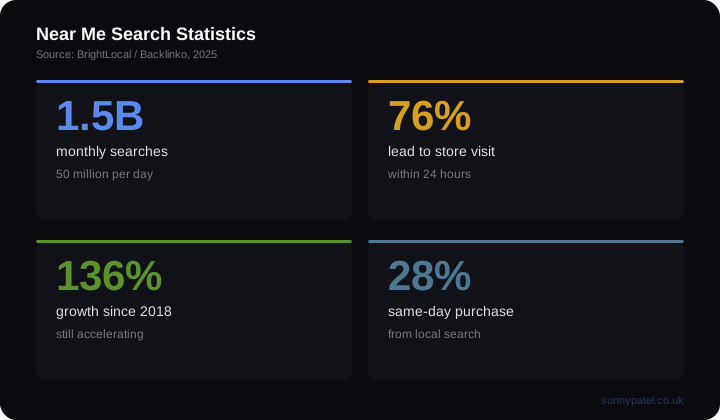
"Near me" searches represent the highest-intent local queries. Someone typing "plumber near me" or "coffee shop near me" is ready to act. The data confirms this.
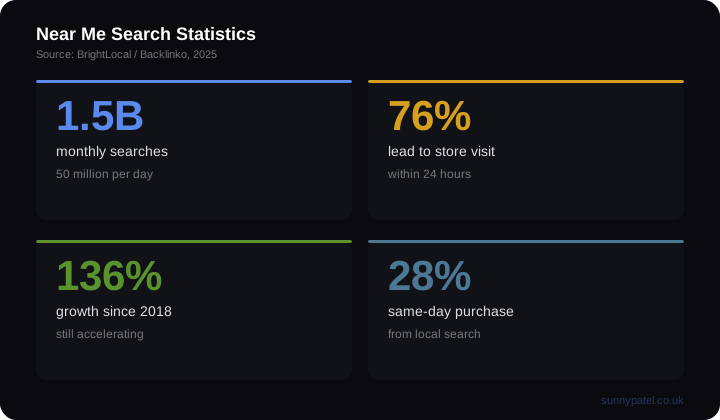
1.5 billion "near me" searches happen globally every month, equating to roughly 50 million per day (BrightLocal). That volume has grown consistently year on year and shows no sign of slowing. The convenience of voice search and mobile-first browsing continues to push these numbers upward.
Since 2018, "near me" searches have surged by 136% (BrightLocal). This is not a temporary trend. Consumer behaviour has permanently shifted toward expecting Google to surface relevant local results instantly.
Specific modifiers are growing even faster. "Open now near me" searches have surged by 400% (BrightLocal). Consumers are not just looking for nearby businesses; they want to know which ones are available right now. This means your Google Business Profile opening hours must be accurate and up to date, including bank holidays and seasonal changes.
The commercial intent behind these searches is extraordinary. 76% of "near me" mobile searches result in a physical store visit within 24 hours (Backlinko). Compare that to display advertising click-through rates of 0.1% or email open rates of 20%. No other marketing channel converts awareness to a physical visit at this rate.
28% of local searches lead to a same-day purchase (Backlinko). More than a quarter of people searching for local businesses buy something that day. This is why ranking in local results is not about vanity metrics. It directly drives revenue.
For Berkshire businesses, these statistics have a specific implication. When someone in Reading searches "accountant near me," Google prioritises businesses with optimised Google Business Profiles, strong reviews, and relevant local content. If your profile is incomplete or your website lacks location-specific pages, you are invisible to these 1.5 billion monthly searches. My local SEO service addresses exactly these gaps.
Google Local Pack Statistics
The Google Local Pack (also called the Map Pack) is the three-business panel displayed at the top of local search results, above organic listings. It includes a map, business names, ratings, addresses, and direct links. Understanding how users interact with it determines your local SEO strategy.
The Local Pack captures 44% of all clicks on local search results pages (BrightLocal). Nearly half of all clicks go to the three businesses displayed in the Map Pack. Organic results below the pack split the remaining clicks. If you are not in the Local Pack, you are competing for less than half the available traffic.
Within the Local Pack itself, the top three results receive 93% of all local pack clicks (BrightLocal). The first position receives a disproportionate share of those clicks, following the same pattern as organic search where position one dramatically outperforms positions two and three.
This creates a clear priority. Ranking fourth in the Local Pack is functionally the same as not ranking at all. The three visible positions collect virtually all the traffic. Every element of your local SEO strategy, from Google Business Profile optimisation to on-page SEO, should aim at securing one of those three positions.
For businesses in competitive Berkshire towns like Reading, Slough, and Bracknell, Map Pack competition is intensifying. I cover the specific strategies for breaking into these local results in the Local SEO Berkshire Guide.
Google Business Profile Statistics
Your Google Business Profile (GBP) is the single most important asset in local SEO. These statistics quantify its impact.
Businesses with complete Google Business Profiles receive 7x more clicks than those with incomplete profiles (Google). Seven times. That is not a marginal improvement. A complete profile includes accurate categories, a full business description, photos, opening hours, services, Q&A, and regular posts.
Complete profiles are also 2.7x more likely to be viewed as reputable by consumers (Google). Trust signals matter enormously in local search. When a potential customer sees a profile with photos, reviews, and detailed information alongside a bare listing with just a name and address, the choice is obvious.
98% of consumers search online for local businesses (BrightLocal). The days when a percentage of your market found you through word of mouth alone, without ever checking you online, are effectively over. Almost every potential customer will encounter your Google Business Profile before they contact you. The question is whether that profile convinces them to enquire or sends them to a competitor.
These numbers reinforce what I see in every local SEO campaign I manage. The businesses that invest time in their Google Business Profile, keeping it complete, posting regularly, responding to reviews, and adding photos, consistently outperform competitors who treat it as a set-and-forget listing. A thorough technical SEO audit of both your website and GBP reveals exactly where you are leaving clicks on the table.
Mobile Local Search Statistics
Local search is overwhelmingly a mobile activity. The data shows exactly how dominant mobile has become.
84% of local searches are conducted on mobile devices (BrightLocal). Desktop local search still exists, but it is a minority. Your website, your Google Business Profile, and every touchpoint in the local search journey must work flawlessly on a phone screen.
30% of all mobile searches are location-related (BrightLocal). Nearly a third of everything people search for on their phones has a local intent. This includes explicit queries like "dentist Reading" and implicit queries like "best pizza" where Google infers local intent from the searcher's location.
Site speed on mobile is critical. 53% of mobile users abandon a website that takes longer than three seconds to load (Google). If a potential customer finds your business in the Local Pack, taps through to your website, and encounters a slow-loading page, more than half will leave before seeing your content. They will tap back and choose the next result.
This is particularly relevant for Berkshire businesses with older websites. A site built five years ago on WordPress with unoptimised images and no caching will struggle on mobile. Page speed is not just a ranking factor; it directly affects whether visitors who find you actually become customers.
Mobile-first local search behaviour also explains why click-to-call, click-for-directions, and click-to-message functionality on your GBP matters. Mobile searchers want to act immediately. Making that action frictionless is part of effective local SEO strategy.
Reviews and Reputation Statistics
Reviews are both a ranking factor and a conversion factor in local SEO. These statistics show their dual impact.
88% of consumers say they would use a business that responds to all of its reviews, both positive and negative (BrightLocal). Review responses demonstrate that a business cares about customer experience. It signals attentiveness and professionalism.
The gap is stark. Only 47% would consider using a business that does not respond to reviews at all (BrightLocal). That is a 41-percentage-point difference in consumer willingness based solely on whether you reply to reviews. No other single action in local SEO creates this kind of trust differential.
Star ratings create hard cut-off points in consumer behaviour. 71% of consumers will not use a business with an average rating below 3 stars (BrightLocal). Below three stars, the majority of potential customers eliminate you before reading a single review. Maintaining a rating above 4 stars is the practical target for competitive local markets.
Review velocity matters too. A business with 200 reviews but none in the past six months raises concerns about whether it is still trading or still delivering quality. Google also factors review recency into local ranking calculations. A steady stream of recent reviews signals an active, trusted business.
For businesses across Reading, Wokingham, Slough, Bracknell, and Maidenhead, review competition varies by sector. Professional services firms may compete with businesses holding 20-50 reviews. Restaurants and retail businesses face competitors with hundreds. Understanding your specific competitive landscape determines your review acquisition targets.
Local SEO Conversion Statistics
Beyond search visibility, local SEO statistics reveal the conversion power of local search traffic compared to other channels.
78% of local mobile searches result in an offline purchase (Backlinko). This statistic encompasses both same-day and near-term purchases. Local search traffic converts at rates that dwarf social media, paid advertising, and email marketing for businesses with a physical presence or service area.
Businesses appearing in the Local Pack see conversion rates 5x higher than businesses relying on organic results alone (BrightLocal). The Map Pack position provides a trust signal (Google has verified your location), immediate access to reviews (social proof), and frictionless contact options (call, directions, website). This combination shortens the decision-making process dramatically.
72% of consumers who perform a local search visit a store within five miles of their current location (Backlinko). Proximity is a powerful filter. This is why service area businesses and multi-location businesses need location-specific content for each area they serve. A single generic service page does not capture searchers five miles away looking for a provider in their specific town.
These conversion statistics make the return on investment case for local SEO straightforward. If 76% of "near me" searches lead to visits and 28% lead to same-day purchases, every position gained in the Local Pack translates directly to additional footfall and revenue.
What These Statistics Mean for Local Businesses
The data points to several clear priorities for any business that serves a local market.
Your Google Business Profile is your most valuable digital asset. The 7x click increase from complete profiles and the 2.7x reputation boost make GBP optimisation the highest-return activity in local marketing. If you have not fully completed your profile, added photos, set up posts, and populated Q&A, start there.
Reviews require active management, not passive collection. The 41-percentage-point gap between businesses that respond to reviews and those that do not is too significant to ignore. Build a systematic process for requesting reviews from satisfied customers and responding to every review within 48 hours.
Mobile performance is not optional. With 84% of local searches happening on mobile and 53% of users abandoning slow sites, your mobile experience directly impacts whether local search visibility converts to revenue.
"Near me" searches are your highest-intent traffic source. 1.5 billion monthly searches with a 76% visit rate within 24 hours represents the most commercially valuable search behaviour in existence. Ranking for these queries requires a combination of GBP optimisation, local content, and technical SEO.
For Berkshire businesses specifically, the competitive landscape for local search is intensifying. Reading, Slough, Bracknell, Wokingham, and Maidenhead all have growing numbers of businesses investing in local SEO. The businesses that act on these statistics now will secure the Local Pack positions. Those that wait will find it increasingly difficult to break in.
I cover Berkshire-specific strategies in detail in the Local SEO Berkshire Guide. For town-specific approaches, see my pages on SEO in Reading, SEO in Wokingham, SEO in Slough, SEO in Bracknell, SEO in Maidenhead, and SEO across Berkshire.
Whether you need a full local SEO campaign or a one-off audit to identify gaps, the statistics above make the case clearly: local search is where your customers are, and visibility in the Local Pack is what drives them through your door.
Sources
- Backlinko — "Near Me" Search Statistics and Local SEO Data (2024)
- BrightLocal — Local Consumer Review Survey (2024)
- BrightLocal — Local Search Industry Report (2024)
- BrightLocal — "Near Me" Searches Study (2024)
- Google — Google Business Profile Performance Data (2024)
- Google — Mobile Site Speed Study (2024)
Related Articles
- Local SEO Berkshire Guide — local SEO strategy for Berkshire businesses
- Local SEO Services — professional local SEO services
- SEO Statistics UK 2026 — broader SEO industry data
- How Long Does SEO Take? — realistic local SEO timelines
Want to know how your business performs against these benchmarks? Contact me for a free 15-minute local SEO consultation and I will show you exactly where your local visibility stands and what it will take to reach the Local Pack.