Reading's business landscape is competitive in ways that most generic SEO guides miss. You are not just competing with other Reading businesses — you are competing with London agencies targeting the M4 corridor, national brands with enormous authority advantages, and local specialists who have been building topical authority for years. This guide covers how SEO in Reading actually works in 2026, what the local search landscape looks like, and what businesses need to do to rank consistently.
Why SEO in Reading Is Different From Other UK Cities
Reading sits at an unusual intersection. It is large enough to have genuine local search volume — over 230,000 residents, a substantial business community across Green Park, Thames Valley Park, and the town centre — but small enough that ranking in the Map Pack and local organic results is genuinely achievable for businesses prepared to invest properly.
Three dynamics make Reading SEO distinct:
The London shadow effect. London-based SEO agencies and businesses actively target Reading and the M4 corridor. A law firm in Mayfair with 15 years of backlink authority competes directly with a Reading solicitor for searches like "commercial property lawyer Berkshire." Winning requires genuine topical depth, not just location optimisation.
Thames Valley B2B concentration. Green Park, Thames Valley Park, and the wider corridor host Oracle, Microsoft, Vodafone, and hundreds of technology and professional services companies. B2B search patterns in Reading are sophisticated — buyers research extensively before engaging. Content that answers questions thoroughly outperforms thin keyword pages.
Commuter search fragmentation. A large portion of Reading's working population commutes to London. They search for local services from mobile devices, often using London-adjacent language. "Near me" searches, postcode-specific queries, and "Reading Berkshire" searches all behave differently and require distinct optimisation strategies.
How Local SEO Works in Reading
Local SEO in Reading operates across three result types that each require different strategies:
Google Map Pack (local 3-pack). When someone searches "accountant Reading" or "SEO consultant Reading," Google shows three Map Pack results above the organic listings. These are driven primarily by Google Business Profile signals — proximity, relevance, and authority built through consistent citations, reviews, and GBP activity. Winning the Map Pack for local service queries should be the first priority for most Reading businesses.
Local organic results. Below the Map Pack, standard organic results appear for service pages, location pages, and blog content. These are driven by on-page optimisation, internal linking architecture, and — critically — topical authority. A Reading business that comprehensively covers its subject area consistently outranks those targeting isolated keywords.
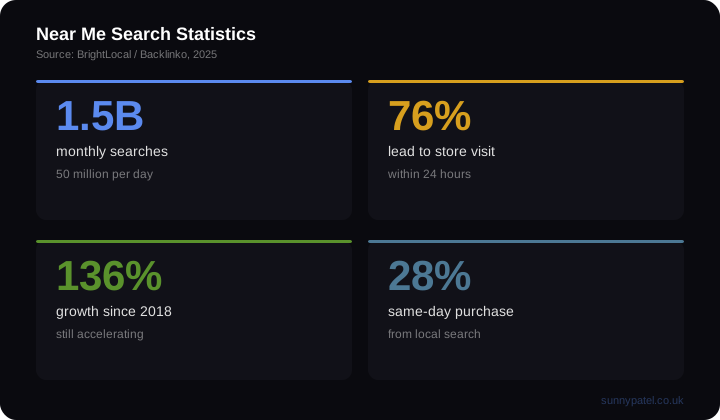
"Near me" and mobile searches. Searches like "SEO agency near me" from Reading postcodes trigger localised results blending GBP and organic signals. Core Web Vitals and mobile performance directly affect these rankings, making technical SEO a prerequisite for local visibility.
The Reading SEO Competitive Landscape
Understanding who you are competing with shapes the entire strategy. Reading's competitive landscape divides into three tiers:
Tier 1 — National brands and London agencies. For broad queries like "SEO consultant" or "accountant Berkshire," national brands and established London agencies with high domain authority compete aggressively. You cannot beat these on broad terms through optimisation alone; differentiation through local specificity and topical depth is the only viable path.
Tier 2 — Established Reading businesses. These are the companies that have been investing in SEO for 3–7 years. They have accumulated backlinks, review signals, and topical coverage. Competing against them requires identifying and filling the content gaps they have not addressed — typically detailed question-answer content, comparison guides, and localised topic clusters.
Tier 3 — Under-optimised local businesses. The majority of Reading businesses in most sectors have thin websites, incomplete GBP profiles, and no content strategy. These are the realistic immediate opportunities — ranking above them through basic local optimisation and systematic content development.
Google Business Profile: The Foundation of Reading Local SEO
For any Reading business serving a local market, Google Business Profile (GBP) optimisation is the single highest-return SEO activity. The steps that move the needle:
Complete every section. Business name, primary category, secondary categories, service areas, opening hours, website URL, phone number, and business description. Incomplete profiles rank below complete ones in every competitive analysis of Reading's local search results.
Primary category selection. Google uses your primary category as the primary relevance signal for Map Pack inclusion. For most service businesses in Reading, this is more specific than you might expect — "SEO Agency" is less effective than "Internet Marketing Service" for consultants; "Accountant" less effective than "Accounting Firm" for specific service targeting.
Reviews. Reading businesses with 10+ Google reviews at 4.5+ rating consistently outrank competitors with fewer reviews in Map Pack positions. A structured review acquisition process — asking every satisfied client directly after project completion — is more effective than passive accumulation. Responding to every review (positive and negative) also influences GBP ranking signals.
GBP posts. Publishing weekly or fortnightly posts signals active management to Google's local algorithm. Posts covering services, offers, and local market insights all contribute. Photos of your team, office (the Landmark Offices Green Park location for locally-serving businesses), and work samples also improve GBP authority.
Service area vs. storefront. Reading businesses that serve clients at the client's location should configure GBP as a service area business covering Reading, Berkshire, and Thames Valley. Businesses with a physical office or meeting space should list it as a storefront with a service area.
On-Page SEO for Reading Businesses
Service pages optimised for Reading should follow a specific structure that combines local signals with topical depth:
Location-specific H1s. "SEO Consultant Reading" performs better than "SEO Consultant" for local intent. The location in the heading signals geographic relevance to search engines processing location queries.
Address and contact details in content. Mentioning your Reading address within page content (not just the footer) provides an additional geographic relevance signal. For businesses operating from a business address like Green Park, this contextualises your local presence.
FAQ sections targeting local variants. Questions like "How much does an SEO consultant in Reading cost?" and "What is the best SEO agency in Reading?" capture long-tail local queries that higher-authority competitors overlook. FAQ schema markup makes these eligible for rich results in Google SERP.
Internal linking to the Map Pack. Service pages should link to the GBP listing (via the Maps embed or direct link) and receive internal links from blog content, the homepage, and related service pages. The more internal links pointing to a location-specific service page, the more authority it accumulates.
Content Strategy for Reading SEO Authority
The Reading businesses that rank most sustainably do not just have optimised location pages — they have content networks that establish genuine expertise in their field. Topical authority means covering your subject comprehensively enough that Google treats your site as a reliable source.
For a Reading accountancy firm, this means not just "Accountant Reading" — it means covering the questions Reading businesses actually research: "How much does an accountant cost for a small business?", "Do I need an accountant or a bookkeeper?", "What records do I need to keep as a sole trader in the UK?" Each piece of content serves a specific search intent while building the topical network that strengthens the commercial pages.
The topical map approach. A topical map documents the full content architecture needed to establish authority. For most Reading professional services and B2B businesses, this means 40–80 pieces of content covering every relevant question cluster. Starting with the 10–15 highest-intent pieces and expanding systematically delivers sustainable ranking improvements rather than the plateau that isolated keyword targeting produces.
Local content integration. Generic content can be enhanced with Reading-specific context: case studies from Thames Valley clients, references to local business challenges, and explicit geographic targeting in headings and body copy. This differentiates content from national competitors publishing identical articles without local context.
Choosing an SEO Consultant or Agency in Reading
Reading's SEO market includes a range of providers from large London agencies with Reading offices to local freelancers and specialist consultants. The 7 questions to ask before hiring an SEO consultant applies regardless of provider size, but local selection involves additional considerations:
Local market knowledge. Does the provider understand Reading's competitive dynamics, the Thames Valley B2B sector, and the specific search patterns of Berkshire audiences? Generic SEO applied without local context misses Reading-specific opportunities and competitive gaps.
Methodology transparency. The most effective SEO strategies for Reading businesses start with a documented topical map and technical audit before any content production. Providers who skip straight to writing blog posts or building links without understanding your topic cluster architecture typically produce short-lived results.
Consultant vs. agency. An SEO agency in Reading typically means a multi-person team with account management; an SEO consultant provides direct expert access. For most Reading SMEs and professional services businesses, a consultant delivers better ROI — you access the strategist making decisions rather than a junior team executing against a brief.
Track record with comparable businesses. A Reading technology company and a Reading restaurant have fundamentally different SEO requirements. Look for providers with demonstrated results in your specific sector and competitive environment, not just generic case studies.
Common SEO Mistakes Reading Businesses Make
The patterns that consistently hold businesses back in Reading's search results:
Thin location pages. A 200-word page with "Looking for an accountant in Reading? We provide accounting services in Reading, Berkshire" does not rank. Location pages need to demonstrate genuine local knowledge, address Reading-specific buyer questions, and provide the content depth that search engines recognise as authoritative.
Ignoring Google Business Profile. Many Reading businesses have unclaimed or incomplete GBP profiles. Competitors claiming the Map Pack for high-intent local searches are extracting leads that these businesses never see. Claiming, completing, and actively managing GBP takes less time than most businesses expect and delivers faster results than any other SEO activity.
Blog content without topical architecture. Publishing individual blog posts without a topical map produces content that does not reinforce each other. Reading businesses that produce 50 isolated blog posts often rank for fewer terms than competitors with 15 posts structured around coherent topic clusters.
Competing on too-broad terms first. Targeting "accountant" or "SEO company" before establishing authority for "accountant Reading" or "SEO consultant Reading" wastes budget and produces no results. The sequence matters: dominate local terms first, expand to regional and national terms as authority accumulates.
Neglecting technical foundations. A slow, mobile-unfriendly website with poor Core Web Vitals rankings above comparable sites with strong technical performance in every competitive analysis. Technical SEO audits identify these issues upfront; addressing them first multiplies the impact of every subsequent SEO investment.
SEO Timeline for Reading Businesses
The most common question: how long before SEO produces results in Reading? The honest answer depends on your starting point, competition level, and what you invest. Realistic benchmarks:
Month 1–3. Technical fixes, GBP optimisation, and initial content production. Google Business Profile improvements often produce Map Pack movement within 6–8 weeks. Organic rankings begin shifting as content is indexed but rarely produce meaningful traffic at this stage.
Month 4–6. Topical authority begins accumulating as content clusters develop. First ranking improvements for lower-competition local terms. Enquiries from organic search start appearing for businesses with strong local optimisation.
Month 6–12. Compound ranking improvements as interconnected content networks strengthen. Competitive local terms increasingly accessible. For most Reading professional services businesses, this is when SEO begins producing consistent leads. Understand how long SEO takes in detail for realistic planning.
Month 12+. Sustainable organic visibility that continues improving without proportional budget increase. The compounding effect that makes SEO the highest long-term ROI marketing channel for most Reading businesses.
Next Steps for Reading Businesses
If your Reading business is not ranking where it should be for your core service terms, the starting point is a clear-eyed assessment of where you currently stand:
- Is your Google Business Profile complete, verified, and actively managed?
- Do your location pages contain genuine depth, or thin keyword-stuffed content?
- Is there a documented content architecture covering your full topic cluster?
- Are there technical issues limiting how Google crawls and indexes your site?
Contact me for a free consultation covering your current visibility, competitive positioning in Reading's market, and a concrete set of first steps. Or explore the specific service pages for Reading SEO consulting, SEO strategy in Reading, and SEO agency alternatives to understand the engagement models available.