
How Many Keywords Should a Website Have? | SEO Strategy Guide
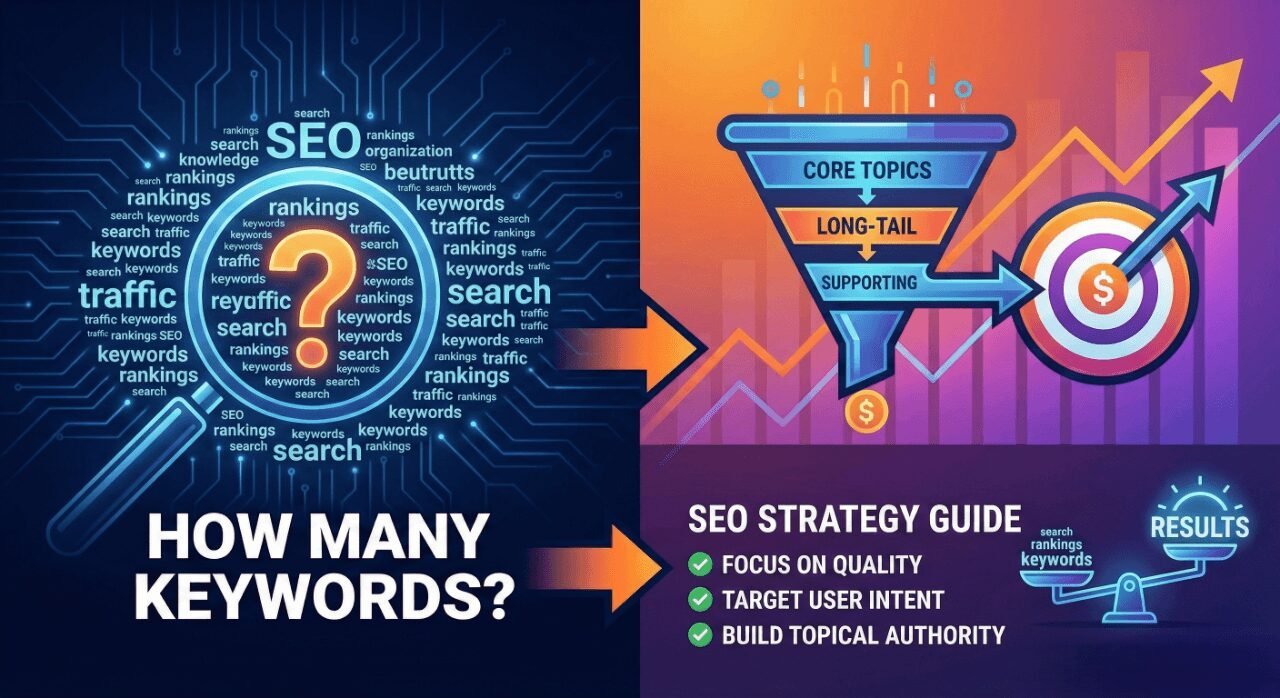
"How many keywords should my website target?" is the wrong question. Here's why, and what to ask instead.
The Flawed Keyword Count Approach
Many businesses create pages targeting arbitrary keyword counts (50 keywords, 100 keywords, 500 keywords). This creates disconnected content lacking strategic cohesion. Rankings remain weak because search engines don't recognise genuine expertise—just isolated keyword targeting.
What Keywords Should I Use? The Right Question
The right question is: "What topics demonstrate expertise in my industry?" This shift moves from keyword counting to topical authority building.
What keywords should I use? Use keywords revealing comprehensive topic coverage in your industry. Target query networks (question clusters) rather than isolated terms. Choose keywords indicating different search intents: informational, commercial, transactional.
The Topical Authority Approach
Instead of counting keywords, map topic spaces:
Step 1: Define your central entity - What is your site primarily about? This becomes your authority anchor.
Step 2: Identify core topics - What major subtopics does your central entity include? These become hub pages.
Step 3: Map supporting queries - What specific questions do users ask about each core topic? These become spoke pages.
Step 4: Cover comprehensively - Address all relevant queries within your topic space, not arbitrary keyword counts.
A plumber might cover 40 keywords comprehensively (types of repairs, emergency services, maintenance guides). A legal firm might need 200+ keywords (practice areas, procedures, common questions). The number emerges from comprehensive coverage, not preset targets.
How Many Keywords Can One Page Target?
One page should target one primary keyword plus related semantic variations search engines understand as the same intent.
For example, a page targeting "kitchen renovation cost" naturally includes:
- kitchen remodel price
- kitchen redesign budget
- cost to renovate kitchen
- kitchen makeover expenses
These aren't separate keywords requiring separate pages. They're semantic variations of one core topic.
Stop creating multiple pages targeting slight keyword variations. This dilutes authority. Create one comprehensive page addressing all related queries.
Practical Keyword Strategy
Here's what works:
Small local businesses (trades, shops, services): 30-60 keywords covering services, locations, common questions, and buying intent terms.
Professional services (consultants, agencies): 80-150 keywords demonstrating expertise through comprehensive topic coverage and thought leadership.
E-commerce sites (product retailers): 200-1000+ keywords covering categories, products, buying guides, and comparison content.
Enterprise/authority sites: 1000+ keywords addressing every relevant query in their industry space.
These aren't targets to hit. They're natural outcomes of comprehensive coverage.
How to Choose Keywords Strategically
Follow this process:
1. Analyse search intent
Group keywords by what users want:
- Informational: "what is X", "how to do Y"
- Commercial: "best X", "X vs Y"
- Transactional: "buy X", "X service near me"
Target each intent type on appropriate pages.
2. Check search volume realistically
Low competition businesses benefit from 100-500 monthly searches per keyword. Competitive industries need 1000+ monthly searches justifying effort.
3. Assess competition honestly
If top 10 results are huge brands with 1000+ pages of content, you need either comprehensive coverage matching theirs or different keyword angles they ignore.
4. Map to business goals
Keywords should lead to conversions. "DIY kitchen renovation" attracts DIYers, not kitchen renovation customers. Choose keywords matching services you offer.
Common Keyword Mistakes
Mistake 1: Targeting keywords you can't rank for
Choosing ultra-competitive head terms without authority to rank wastes effort. Start with lower-competition variations building toward head terms.
Mistake 2: Keyword stuffing
Using keywords unnaturally or repeatedly damages readability and rankings. Write naturally. Search engines understand semantic context.
Mistake 3: Ignoring search intent
Targeting "cheap X" when you sell premium X attracts wrong audience. Match keywords to what you actually offer.
Mistake 4: Creating thin content
Publishing 200-word pages targeting keywords produces thin content search engines ignore. Comprehensive pages targeting topic clusters work better.
What About Long-Tail Keywords?
Long-tail keywords (3-5+ words, specific queries) often convert better than short-tail keywords despite lower search volume.
"emergency plumber north reading sunday night" converts better than "plumber reading" because intent is specific and immediate.
Target long-tail through comprehensive topic coverage, not dedicated pages for each variation. One comprehensive service page ranks for dozens of related long-tail queries naturally.
How to Build a Keyword List
Method 1: Use keyword research tools
Tools like Google Keyword Planner, Ahrefs, or SEMrush reveal search volumes and related queries. Export related keywords for your core topics.
Method 2: Analyse competitors
See what keywords competitors rank for. Identify gaps where they lack coverage or opportunities where they have weak content.
Method 3: Mine Search Console
Review queries already driving impressions. Find keywords where you rank positions 6-15 with optimisation opportunity.
Method 4: Map customer questions
What do customers ask during sales conversations? These questions become keyword opportunities.
My keyword research service combines these methods, delivering prioritised keyword lists mapped to recommended page structures.
Stop Counting, Start Covering
The goal isn't reaching arbitrary keyword counts. The goal is comprehensive coverage demonstrating genuine expertise.
A site ranking for 50 highly relevant keywords with strong conversions outperforms a site ranking for 500 irrelevant keywords generating worthless traffic.
Focus on:
- Comprehensive topic coverage
- Search intent matching
- Content quality over quantity
- Semantic relevance over keyword repetition
This approach builds topical authority search engines reward with sustained rankings and query expansion capturing related searches automatically.
Next Steps
Instead of asking "how many keywords?", ask:
- What topics demonstrate my expertise?
- What questions do my customers ask?
- What searches lead to conversions?
Answer these questions comprehensively and keyword counts take care of themselves.
Need help identifying which keywords matter for your business? Contact me for a free keyword gap analysis showing opportunities competitors miss.